Study Apps With a Virtual Pet: How to Choose One That Helps
A cute study timer can make starting easier, or quietly add guilt. Compare the punishment and warmth models and check 8 things before you download.

On this page
- Why can a virtual pet make studying easier?
- What are the risks of gamified study apps?
- Punishment vs. warmth: two ways apps keep you coming back
- What to look for: a checklist before you download
- Types of study apps with pets and other rewards
- How Study Buddy Cat does it (our app)
- How to test any study app in one week
- Frequently asked questions
In short
- A study app with a virtual pet works best as a starting ramp: it makes focus time visible and gives you a small, friendly reason to begin.
- Apps bring you back with punishment (a tree dies, progress is lost) or warmth (rewards for showing up, nothing earned is taken away); pick the one that makes you more willing to start tomorrow.
- Before you download, check whether the app verifies real study time, shows ads, needs an account, works offline, respects your privacy and can take your progress away.
If you want a study app with a virtual pet, look for one that turns verified focus time into something you can see (food for a pet, a growing tree, a changing room) without punishing you when life gets in the way. The pet's job is to make starting easier and progress visible. It can't learn the material for you, and it shouldn't make you feel worse on a bad day.
Gamified study apps fall into two camps. Some raise the stakes: leave early and your tree dies or your progress disappears. Others use warmth: you're rewarded for showing up, and nothing you've earned is taken away. Both can work; which one suits you depends mostly on how you react to a missed day.
Full disclosure: we make Study Buddy Cat, a study timer where every focused minute feeds a virtual cat. This guide keeps our app in one clearly labeled section and spends the rest on how to judge any app in this category. Compare and decide for yourself.
Why can a virtual pet make studying easier?
Most study problems aren't about knowing what to do. They're about starting, and about keeping going when the payoff is weeks away. A pet on your screen helps with both.
- It makes invisible effort visible. Twenty-five minutes of reading leaves no trace. A fed cat or a grown tree does, and that small, immediate signal bridges the gap until the real reward arrives.
- It lowers the bar to start. "Feed the cat for ten minutes" feels lighter than "study chemistry." Researchers describe procrastination as largely a way of escaping a bad mood about a task in the moment (Sirois & Pychyl, 2013), so a friendlier first minute helps.
- It keeps you company. A character that "studies" next to you is a light version of body doubling: work often feels easier when someone is with you.
- It turns a timer into a routine. Checking on your pet becomes a cue to start a session. Cues are a big part of how a study habit forms.
What about gamification in general? A widely cited review of empirical studies found mostly positive effects, but they depended heavily on the context and on the people using it (Hamari et al., 2014). Game elements can help. They aren't magic, and they don't suit everyone.
What are the risks of gamified study apps?
The pet measures time, not learning. An hour of rereading feeds the pet just as well as an hour of practice questions, even though testing yourself does far more for memory. Use the app to protect your time, then fill that time with methods that work.
Rewards can crowd out your own reasons. A large meta-analysis found that expected, tangible rewards tended to lower intrinsic motivation for tasks people already found interesting, while positive feedback tended to raise it (Deci et al., 1999). The lesson for studying is mild: treat the pet as a ramp and a source of feedback, and keep your own reason in view.
The pet can become the distraction. Outfits, shops, mini-games and notifications can eat the time they were meant to protect. Look for extras that unlock after you focus.
Guilt and streak pressure. If an app makes you feel like a failure every time you miss a day, it can push you away from studying. That leads to the biggest design choice in this category.
Punishment vs. warmth: two ways apps keep you coming back
Every gamified study app has to answer one question: what happens when you leave early or skip a day?
The punishment model raises the stakes. Leave mid-session and your tree withers; skip days and your pet looks neglected, or progress is lost. Losing something you built feels bad, and that's the point: in the moment, it's a strong reason to stay put. Plenty of students like this, especially for short, intense pushes before an exam.
The warmth model rewards showing up and never takes away what you've earned. Leaving early just means fewer minutes count; after a missed day your pet might miss you, but one session fixes that. Honesty comes from separate tools (pausing when you leave the app, presence checks, app blocking) rather than from threats.
| Situation | Punishment model | Warmth model |
|---|---|---|
| You leave the app mid-session | You lose this session's reward (for example, the tree dies) | The timer pauses or stops counting; what you already earned stays |
| You miss a day | Your pet or your progress may suffer | Your pet misses you; one session cheers it up again |
| You come back after a rough week | You may face visible damage first | You pick up where you left off |
| Who it tends to suit | People who like stakes and short, intense pushes | People who quit after "breaking" something, or who study with a lot of worry |
Why might warmth matter? In one study, students who forgave themselves for procrastinating before a first exam procrastinated less before the next one (Wohl et al., 2010). And in a study of everyday habit formation, missing a single day did not materially affect the process (Lally et al., 2010). Your brain is more forgiving than a strict app. If a dead tree makes you avoid the app for a week, the punishment costs more than it gives.
None of this makes the punishment model wrong. Ask one honest question instead: after a bad day, does this app make you more or less likely to open it tomorrow?
What to look for: a checklist before you download
Cute art is easy to judge from screenshots. These points aren't, so check them on purpose.
| What to check | Why it matters | How to check in five minutes |
|---|---|---|
| Verified time | If the timer keeps running while you scroll elsewhere, the pet rewards the wrong thing | Start a session, switch to another app for a minute and see what's counted |
| Ads | Ads in a focus app pull you toward other apps | Look for "Contains ads" on the store page |
| Account wall | A sign-up screen is one more reason not to start | Install it and see whether you can begin a session right away |
| Offline use | Libraries, trains and data limits are real | Turn on airplane mode and run a short session |
| Privacy | Many users are teens, and less data is safer | Read the privacy label or data safety section and look for tracking |
| Can progress be lost? | Losing weeks of progress after one bad day is a classic reason people quit | Read the FAQ: what happens if you leave early, miss days or stop paying? |
| Languages | Studying is easier in your own language | Check the language list on the store page |
| Distraction tools | Your phone is the main competitor for your attention | Look for app blocking, Do Not Disturb support or a strict mode |
Also check what the free version covers before you get attached. And if your phone is the main problem, pair any app with these ways to stop using your phone while studying.
Types of study apps with pets and other rewards
Each type below has a well-known example, described by its core idea. Apps change, so check the current store page before you decide.
Grow-a-tree apps
Forest is one of the best-known gamified focus apps. You grow a virtual tree while you stay off your phone, and leaving early can kill the tree; over time, your sessions add up to a forest. It's the clearest example of the punishment model, and its simplicity is a big part of the appeal.
Companion pet focus timers
Study Bunny and Focus Friend are cute companion apps: a character keeps you company while you focus, and your focus time turns into rewards for it. How strict each one is about leaving early can differ, so run them through the checklist above.
Self-care pets
Finch is a self-care pet app: you look after a small bird by setting goals and checking in on your habits and mood. It's gentle and well liked, but it isn't built as a study timer, so you'd still need a separate timer for focus sessions.
Study timers with groups and rankings
YPT (Yeolpumta) is a study timer that measures study time by subject, with study groups and rankings. There's no pet; the motivation is social. Comparison can push you, but it can also discourage you when others post very long hours.
Not sure which type fits? Think about what usually gets you to sit down: building something, caring for something or keeping up with others. Then test one app of that type.
How Study Buddy Cat does it (our app)
This is our app, so read this as a description, not a review. Here's how it handles the checklist, including what it doesn't do.
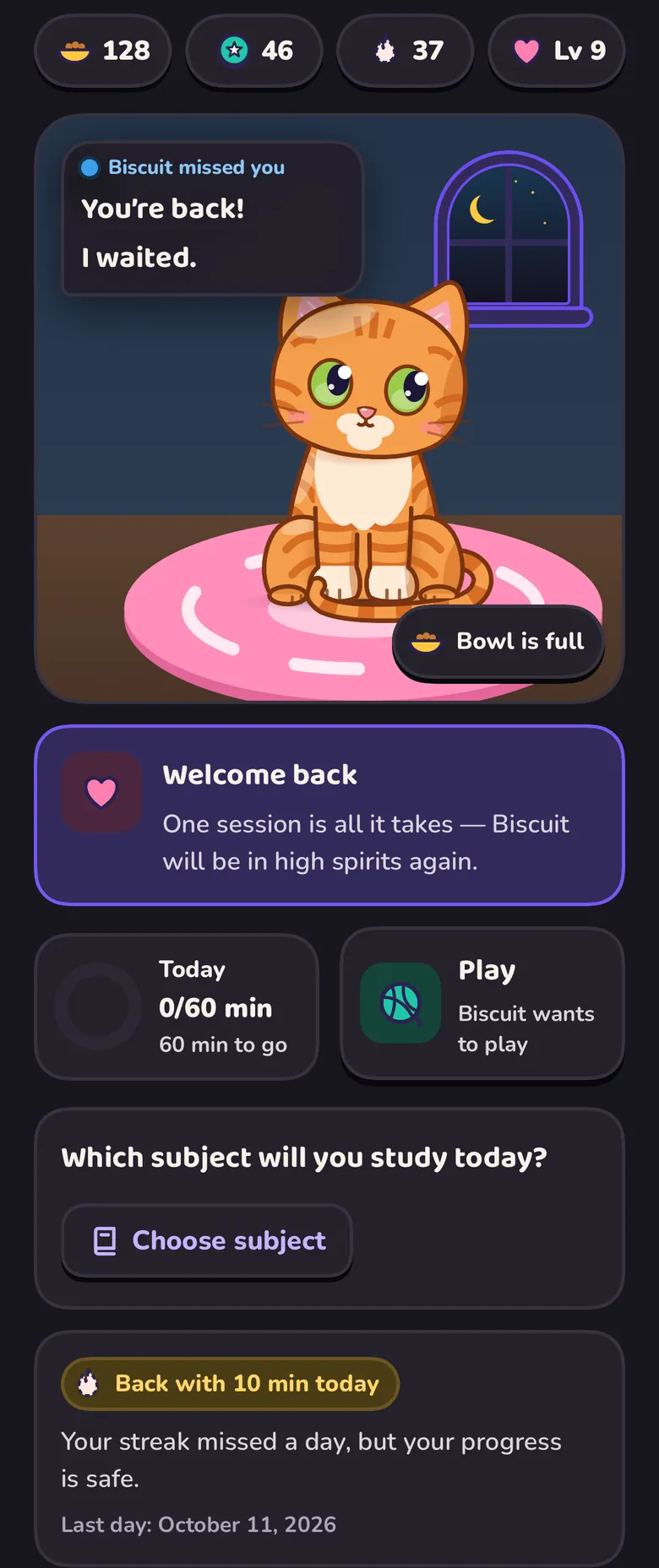
- Verified time. Every verified minute of focus becomes 1 food for your cat. If you turn on the paw check (it's off by default; you'll find it in Profile → Focus), the cat asks now and then, "Meow! Are you there?" If you don't answer, the session pauses from that point, so only real study time counts. With strict mode on, staying out of the app for more than 10 seconds ends the session and costs you its rewards; locking the screen doesn't count.
- Warmth, not punishment. The cat always waits for you. When you're away, the cat misses you, and one session is enough to cheer the cat up again. Your level goes up as you focus and never goes down, and new levels bring room items. Your bond with each cat grows with the days you study together. Street cats visit the window when you save extra food.
- Streaks without fear. You set a daily goal (5 to 360 minutes) and your study days; rest days never break the streak. A streak shield protects a missed day, and you can often save your streak the next day. If a streak breaks, only the counter resets.
- Breaks stay breaks. Four mini-games unlock once you've focused today. Games never replace studying.
- Easy start. No account or paywall to start, no ads, no tracking, works offline, 13 languages.
- Phone tools. Deep focus uses Screen Time on iPhone to block the apps you choose; on Android, it uses Do Not Disturb plus gentle reminders.
What it doesn't do: it's a timer and a companion, not a flashcard or note-taking app, so you still need good study methods. The app is on Google Play and the App Store. Some extras (advanced stats, your own cat drawn from a photo, premium cats and room themes) are part of an optional subscription; the study loop doesn't need it.
How to test any study app in one week
A week of real use tells you more than any screenshot.
- Pick one app and one small goal. Twenty or thirty minutes a day is enough. Note roughly how much you studied last week as a baseline.
- Set it up before day one. Turn off notifications you don't need, choose a timer length (a 25-minute Pomodoro block is a good default) and decide where your phone goes during sessions.
- Attach it to a cue. Start at the same moment each day, for example right after dinner.
- Try one early exit on purpose. See what the app does when you leave mid-session, and how that feels.
- Watch your reaction to a missed day. Do you want to come back, or to avoid the app?
- Compare on day seven. Put your verified minutes next to your baseline.
If no app fits, a plain timer and a paper log work too: the pet is optional, the habit is the point. If starting at all is the hard part, try these ways to stop procrastinating or browse more articles on motivation.
Frequently asked questions
Do study apps with a virtual pet actually work?
They can help you start more often and see your progress. Research on gamification shows mostly positive but mixed results that depend on the person (Hamari et al., 2014), so test one for a week and look at your real minutes.
Is there a Forest alternative without punishment?
Yes. Some apps use the warmth model instead: they reward showing up and don't take away what you've earned when you leave early or miss a day. Read each app's FAQ, because the details vary.
Can a pet app become a distraction itself?
Yes, if shopping, dressing up or games take more time than focusing. Prefer apps where extras unlock after you've studied, and keep notifications to a minimum.
Are these apps safe for teenagers?
Check whether there are ads, whether an account is required and what the privacy label says about tracking. If you're under 18, it's a good idea to pick an app together with a parent or guardian.
Sources and further reading
- Hamari, J., Koivisto, J., & Sarsa, H. (2014). Does gamification work? A literature review of empirical studies on gamification. Proceedings of the 47th Hawaii International Conference on System Sciences, 3025–3034.
- Deci, E. L., Koestner, R., & Ryan, R. M. (1999). A meta-analytic review of experiments examining the effects of extrinsic rewards on intrinsic motivation. Psychological Bulletin, 125(6), 627–668.
- Sirois, F., & Pychyl, T. (2013). Procrastination and the priority of short-term mood regulation: Consequences for future self. Social and Personality Psychology Compass, 7(2), 115–127.
- Wohl, M. J. A., Pychyl, T. A., & Bennett, S. H. (2010). I forgive myself, now I can study: How self-forgiveness for procrastinating can reduce future procrastination. Personality and Individual Differences, 48(7), 803–808.
- Lally, P., van Jaarsveld, C. H. M., Potts, H. W. W., & Wardle, J. (2010). How are habits formed: Modelling habit formation in the real world. European Journal of Social Psychology, 40(6), 998–1009.

By the Study Buddy Cat team
We are the small team behind Study Buddy Cat, a study timer where every focused minute feeds a cat. We write about the study habits we build into the app, drawing on learning research and on what students tell us.
Keep reading
-
 Motivation and habits
How to Build a Study Habit: A 30-Day Plan That Sticks
Most habits take longer than 21 days. Use a cue, a tiny daily minimum, the never-miss-twice rule and planned rest days, with a 30-day plan you can copy. -
 Focus
Pomodoro Technique for Studying: A Step-by-Step Guide
What the Pomodoro Technique is, how to run 25/5 cycles, why short breaks help, and how to adjust the timer for math, memorization and reading. -
 Focus
How to Stop Using Your Phone While Studying: What Actually Works
Your phone pulls at your attention even on silent. Move it, mute apps (not people) and set up Screen Time or Digital Wellbeing, step by step.
Make your next study session count
Study Buddy Cat turns every verified minute of focus into food for your cat. No account or paywall to start, no ads, and when you take a break, your cat waits for you.