How to Build a Study Habit: A 30-Day Plan That Sticks
Most habits take longer than 21 days. Use a cue, a tiny daily minimum, the never-miss-twice rule and planned rest days, with a 30-day plan you can copy.

On this page
- How long does it take to build a study habit?
- Start smaller than feels useful: cue, minimum and place
- A 30-day starter plan for a daily study routine
- Never miss twice: what to do after a missed day
- Plan rest days on purpose
- Do study streaks help or hurt?
- What if your study habit falls apart?
- Frequently asked questions
In short
- Tie a short, fixed study session to something you already do every day, and set the minimum low enough for your worst day.
- In the best-known study of real-life habit formation, the median time to automaticity was 66 days (range 18–254), so plan for about two months, not 21 days.
- One missed day barely matters; two in a row starts a new pattern, so never miss twice and decide your rest days in advance.
- A study streak is a tool for showing up, not the goal itself; also track a number that can't drop to zero, like study days this month.
To build a study habit, attach a short, fixed study session to a cue you already have every day (getting home, finishing dinner, sitting down on the bus) and make the minimum so small that you can still do it on a bad day. Ten to fifteen minutes is plenty. Study in the same place, decide your first task the night before, and mark every study day somewhere you can see it.
Then plan for the days it goes wrong. Choose your rest days in advance, and when you miss a study day, don't miss the next one too. That "never miss twice" rule matters more than a perfect streak: in the best-known study of how habits form in real life, a single missed day didn't materially slow people down, and the typical person needed about two months, not three weeks, before a new daily behavior felt automatic.
How long does it take to build a study habit?
The number you've probably heard is 21 days. It goes back to a popular self-help book from the 1960s, not to research on habits. The closest thing to a real answer comes from Phillippa Lally and colleagues at University College London (Lally et al., 2010).
In the study, 96 volunteers each picked one simple eating, drinking or exercise behavior and did it in the same situation every day, such as "after breakfast", for 12 weeks. Each day they rated how automatic it felt. The findings:
- Automaticity grew fast at first, then leveled off, like a curve that flattens.
- The median time to reach that plateau was 66 days.
- The range was huge: 18 to 254 days. The study lasted 12 weeks, so the longest times were estimated from each person's curve, but the message is clear: some habits settle in weeks, others take months.
- Missing one day didn't materially affect habit formation. A single gap didn't send anyone back to the start.
So if studying still feels like effort in week three, nothing is wrong with you; that's the normal shape of the curve. Studying also has more steps than drinking a glass of water (finding your notes, choosing a task, getting started), so it's sensible to plan for the longer side. Your job for the first two months: many repetitions in the same context. Long hours can come later.
Start smaller than feels useful: cue, minimum and place
A habit is a behavior your brain has linked to a situation. When the situation shows up, the behavior starts with very little deciding. That's why setup matters more than willpower: every repetition strengthens the link between the cue and the action.
The most reliable way to set it up is an if-then plan, which psychologists call an implementation intention. In Peter Gollwitzer's research, people who decided in advance when, where and how they would act were more likely to follow through than people who only intended to (Gollwitzer, 1999). For studying, the template is: "After I [cue], I will study [task] for [minutes] at [place]." For example:
- "After I put my school bag down, I'll do 15 minutes of math at my desk."
- "After dinner, I'll review my biology flashcards for 10 minutes at the kitchen table."
- Pick an anchor that already happens on every study day at a predictable time: getting home, dinner, a class ending. Avoid "when I feel like it" or a clock time you often miss.
- Set a minimum you could hit while tired, usually 10–15 minutes. It's the floor, not the target; anything extra is a bonus.
- Fix the place: same desk, same library seat. Put your phone in another room or at least out of reach.
- Decide the first task the night before. "Chemistry, questions 1–6 on page 84" beats "study chemistry". Starting is the hardest moment, so take the decision out of it.
- Make it visible. Mark the day on a paper calendar, a habit tracker or an app the moment you finish.
Why so small? A minimum you hit on 26 of 30 days builds more habit than an ambitious plan you hit on 9. If you're ten minutes in and want to keep going, keep going. Just don't raise the bar you have to clear tomorrow.
Make those minutes count with active methods. In a large review of study techniques, practice testing and spreading study over time came out on top, while rereading and highlighting were rated low (Dunlosky et al., 2013). Short daily sessions are spaced practice almost by default, and quizzing yourself fits easily into ten minutes; the guide to active recall and spaced repetition shows how.
A 30-day starter plan for a daily study routine
Before day 1, choose your study days. Six days a week with one planned rest day is a good default; five works if your weekends are already full. The minimum applies to study days only, because rest days are part of the plan.
| Days | Minimum per study day | What to do | Focus of the week |
|---|---|---|---|
| 1–7 | 10 min | One small task right after your cue: a few practice problems, 20 flashcards, or one page of notes rewritten from memory | Show up at the same cue; nothing else matters yet |
| 8–14 | 15 min | Start each session by quizzing yourself on yesterday's material | Write down your bad-day version (see below) |
| 15–21 | 25 min | One focused block, such as a Pomodoro, on your hardest subject | Prepare the first task the night before, every time |
| 22–30 | 25 min, two blocks on strong days | Mix subjects; use one session a week to review older topics | Weekly review: which cue worked, one change |
On day 30, count how many planned study days you actually studied. Around 80 percent or more (say, 21 of 26)? Keep the cue and raise the minimum a little. Lower? The cue or the minimum needs fixing, not you. Change one thing and run the next 30 days. And don't expect it to feel automatic yet: with a 66-day median, month two is about keeping the same cue while the amount grows slowly.
Never miss twice: what to do after a missed day
The missed day isn't the problem; what it turns into is. One miss becomes "I've already ruined it", and the second and third days follow without a decision. The rule "never miss twice", popularized by James Clear in Atomic Habits, catches exactly that moment: one miss is an accident, two in a row is the start of a new pattern.
- Have a bad-day version ready. For example: "If I get home after 9 p.m., I'll do five minutes: ten flashcards or one practice problem." It's another if-then plan, aimed at the obstacle instead of the goal.
- The day after a miss, do your normal minimum at your normal cue. Don't make up the missed time with a double session; a punishing catch-up makes the next session something to dread.
- Skip the guilt. First-year university students who forgave themselves for procrastinating on studying for their first exam procrastinated less before the next one (Wohl et al., 2010). Harsh self-criticism feels responsible, but mostly makes you want to avoid the task. If avoidance is the real issue, read how to stop procrastinating.
- Fix the setup, not your opinion of yourself. Did practice run late and swallow your cue? Was the minimum too big? Change the plan and keep going.
Plan rest days on purpose
A rest day you chose in advance is part of the habit. A day you skipped is a miss. You studied zero minutes both times; the difference is that one was a decision and the other just happened.
Planned rest keeps the plan honest about your actual life (family Sundays, tournaments and late shifts exist), gives you time to recover so study days stay focused, and removes the "every single day, forever" pressure that can make people quit after their first unavoidable gap.
- One rest day a week is a good default. Take two if your study days are long, for example in the final weeks before a big exam.
- Fix the day if you can. "Saturday is off" is easier to keep than deciding every week. If your schedule shifts, choose next week's rest day on Sunday evening.
- Actually rest. Half-studying with a guilty conscience is neither study nor rest.
- Plan holidays before they start. A holiday version (three study days a week, a shorter minimum, the same cue if it still exists) keeps the habit alive. An unplanned break is much easier to drift out of.
Do study streaks help or hurt?
Both. A streak, the number of study days in a row, turns invisible progress into a number you can watch grow. That helps most in the first weeks, when studying itself doesn't feel rewarding yet, and it gives you a reason to do the five-minute version instead of nothing.
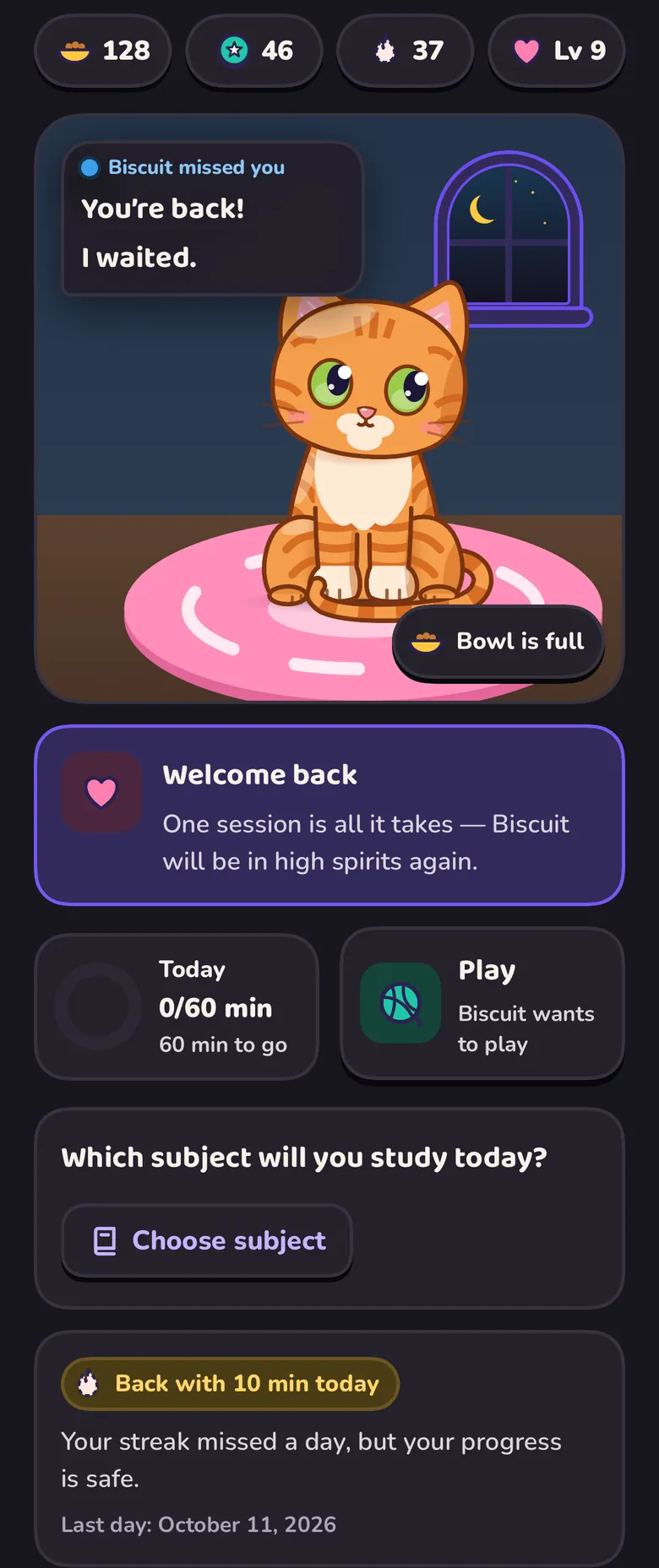
The downside is all-or-nothing thinking. When a long streak breaks, it can feel like the whole effort is gone, and some people quit right there, even though one missed day changes almost nothing about the habit or what they've learned. Other traps: "junk minutes" at 11:50 p.m. just to keep the number, picking easy tasks to protect the count, and a low-level anxiety that turns studying into a debt you owe the counter.
| A streak that helps | A streak that hurts |
|---|---|
| The daily bar is low enough for bad days | The bar is so high that one hard day breaks it |
| Planned rest days don't break it | Every day must count, so you never rest |
| A break resets the counter and nothing else | A break feels like losing everything |
| It measures showing up | It becomes the goal instead of learning |
| You also track study days this month | The streak is the only number you look at |
That last row is the key to study consistency. "22 of 26 study days this month" says more about your habit than a streak that just reset, and one bad Tuesday can't wipe it out. Once a week, take five minutes: which days did I hit, where did the cue fail, and what one thing (cue, place, minimum or first task) will I change next week? Decide now what happens when a streak ends: "I restart at my minimum on the next study day."
What if your study habit falls apart?
At some point it will: holidays, illness, a new timetable, a month of exams. Restarting is a skill, and it works best when you make it easy:
- Go back to the week-1 minimum, not to where you left off. Ten minutes at your cue is a restart; ninety minutes is a test you'll probably fail.
- Check whether your cue still exists. A new timetable often deletes the old anchor, so pick a new one.
- Don't catch up in one sitting. List what you missed and spread it over the next two weeks.
- If you can't start at all, the problem is usually how the task makes you feel, not a lack of time. These ideas on study motivation help you get moving again.
The habit you're building isn't "study every single day, forever". It's "when my cue comes, I sit down and start", and that survives a missed day, a rest day and a broken streak. For more on routines, browse the motivation and habits articles.
Frequently asked questions
Is it better to study every day or in a few long sessions?
For building the habit and for remembering material, shorter sessions spread over the week usually win: spacing study out beats cramming the same total time into one sitting (Cepeda et al., 2006). Long sessions are fine on top of a daily minimum, not instead of it.
How many minutes a day should I start with?
Ten to fifteen minutes on each study day. Choose an amount you could manage on your worst day, and raise it only after a few steady weeks.
Does breaking a study streak mean starting over?
Only the number starts over. What you learned and the link between your cue and studying are still there. Restart at your minimum on the next study day.
Is 21 days enough to build a habit?
Sometimes. The fastest participants in Lally et al. (2010) got there in 18 days, but the median was 66, so treat the first two months as the building phase and don't judge yourself on day 21.
Sources and further reading
- Lally, P., van Jaarsveld, C. H. M., Potts, H. W. W., & Wardle, J. (2010). How are habits formed: Modelling habit formation in the real world. European Journal of Social Psychology, 40(6), 998–1009.
- Gollwitzer, P. M. (1999). Implementation intentions: Strong effects of simple plans. American Psychologist, 54(7), 493–503.
- Wohl, M. J. A., Pychyl, T. A., & Bennett, S. H. (2010). I forgive myself, now I can study: How self-forgiveness for procrastinating can reduce future procrastination. Personality and Individual Differences, 48(7), 803–808.
- Cepeda, N. J., Pashler, H., Vul, E., Wixted, J. T., & Rohrer, D. (2006). Distributed practice in verbal recall tasks: A review and quantitative synthesis. Psychological Bulletin, 132(3), 354–380.
- Dunlosky, J., Rawson, K. A., Marsh, E. J., Nathan, M. J., & Willingham, D. T. (2013). Improving students' learning with effective learning techniques: Promising directions from cognitive and educational psychology. Psychological Science in the Public Interest, 14(1), 4–58.

By the Study Buddy Cat team
We are the small team behind Study Buddy Cat, a study timer where every focused minute feeds a cat. We write about the study habits we build into the app, drawing on learning research and on what students tell us.
Keep reading
-
 Motivation and habits
How to Get Motivated to Study When You Don't Feel Like It
Motivation usually shows up after you start, not before. Here's how to start anyway: a 10-minute rule, a WOOP worksheet, visible progress and a bad-day plan. -
 Motivation and habits
How to Stop Procrastinating on Studying (Without Guilt)
Procrastination is mood repair, not laziness. See why you put off studying, then use a 10-minute start, if–then plans and self-forgiveness to begin today. -
 Motivation and habits
Study Apps With a Virtual Pet: How to Choose One That Helps
A cute study timer can make starting easier, or quietly add guilt. Compare the punishment and warmth models and check 8 things before you download.

Make your next study session count
Study Buddy Cat turns every verified minute of focus into food for your cat. No account or paywall to start, no ads, and when you take a break, your cat waits for you.