How to Stop Procrastinating on Studying (Without Guilt)
Procrastination is mood repair, not laziness. See why you put off studying, then use a 10-minute start, if–then plans and self-forgiveness to begin today.
On this page
- Why do you procrastinate on studying? It's not laziness
- The 10-minute start: make the task smaller than your resistance
- How do if–then plans help you stop procrastinating?
- Make the escape harder than the start
- Perfectionism: when "not now" really means "not good enough"
- Forgive yourself for yesterday (it makes tomorrow easier)
- How to stop procrastinating on studying today: a step-by-step plan
- Frequently asked questions
In short
- Procrastination is mostly a way to escape a bad feeling about a task, not laziness, so the fix is a smaller, safer start, not self-criticism.
- Shrink the task to a 2- or 10-minute first step, and decide in advance with an if–then plan exactly when and where you'll start.
- Make distractions harder to reach, and forgive yourself for past delays; in one study, students who forgave themselves procrastinated less before the next exam.
If you want to stop procrastinating on studying, don't wait until you feel motivated. Procrastination usually isn't laziness or bad time management. It's a way of escaping a bad feeling that the task brings up: boredom, confusion, the fear of doing badly. Putting it off makes you feel better right now, and that quick relief keeps the pattern going. As psychologists Fuschia Sirois and Timothy Pychyl put it in a 2013 review, procrastination puts short-term mood repair ahead of the goals of your future self.
So the fix isn't more willpower. It's making the start so small and so clearly planned that the bad feeling has less to push against:
- Shrink the task to a first step you could do in 2 to 10 minutes.
- Decide when and where you'll start with an "if–then" plan.
- Make the easiest escape, usually your phone, harder to reach.
- Forgive yourself for yesterday, so guilt doesn't weigh down today's start.
In a hurry? Jump straight to the start-today plan.
Why do you procrastinate on studying? It's not laziness
Psychologist Piers Steel defines procrastination as voluntarily delaying something you intend to do even though you expect the delay to leave you worse off. That's what separates it from resting: you know the essay is due Friday, you want it done, and you still open another video.
In his 2007 meta-analysis of a large body of research, Steel found procrastination was most consistently linked to four things:
- how unpleasant the task feels,
- how far away the deadline or reward is,
- how confident you are that you can succeed,
- how impulsive or easily distracted you are.
Notice what's missing: being a bad person. Sirois and Pychyl add the emotional piece. When a task makes you feel bored, anxious, confused or not good enough, avoiding it brings instant relief, and your future self pays the bill. You're not really choosing fun over work. You're choosing not feeling bad right now over a goal you genuinely care about.
The useful question, then, isn't "Why am I like this?" but "What feeling am I avoiding?" Each one has a different fix:
| What the task feels like | What you tell yourself | What helps |
|---|---|---|
| Boring | "I'll do it when I'm in the mood." | A short timer, a small reward afterward, or studying next to someone |
| Confusing | "I don't even know where to start." | Write the very first physical action; ask one specific question |
| Too big | "This will take forever." | Cut it into 10-minute pieces and do only the first one |
| Scary | "If I try and still fail, that's worse." | Aim for a rough first attempt, not a good one |
| Far away | "The exam is weeks away." | Set a mini-deadline for this week and tell someone |
The 10-minute start: make the task smaller than your resistance
For most people, the hardest part of studying is the first few minutes. "Study chemistry" is so vague that your brain can't picture a first step, so it pictures the whole thing at once, and that feels awful. Make the first step so small and concrete that it barely sets off the bad feeling.
Pick the version that matches how stuck you feel:
- The 2-minute start, for when you can't face anything. Do only the first physical action: open the book, write the date and the essay title, copy out the first problem. Then you're allowed to stop.
- The 10-minute start, for when you can manage a bit more. Set a timer for 10 minutes and work on one clearly defined piece. When it rings, you can genuinely stop. Often you won't want to, because the task turned out less awful than predicted, but the deal only works if stopping is a real option.
Here's what shrinking looks like in practice:
| Instead of… | Start with… |
|---|---|
| "Study for the history test" | "Write five questions about chapter 6 from memory" |
| "Write my essay" | "Write three messy bullet points for the intro" |
| "Do my math homework" | "Copy problem 1 and write down what it's asking" |
| "Learn my Spanish vocab" | "Quiz myself on the first 10 words of the list" |
| "Review biology" | "Draw the cell diagram from memory, then check it" |
A good first step starts with a verb and has a clear finish line. Once 10 minutes feels normal, stretch to a full block: a 25-minute round of the Pomodoro technique keeps the same promise: you only work until the timer rings.
How do if–then plans help you stop procrastinating?
Deciding to study isn't the same as deciding when, where and how you'll start. Psychologist Peter Gollwitzer calls the second kind an implementation intention: a plan in the form "If situation X happens, then I will do Y." In a 1999 review, he described how these simple plans help people act on goals they already have: the decision is made ahead of time, and the situation itself becomes the cue to begin. No negotiating with yourself at 5 p.m., because the deal was made at breakfast.
It has been tested with teenagers, too. In a 2011 study by Angela Duckworth and colleagues, high school students preparing for the PSAT learned to combine mental contrasting (picturing the goal, then the obstacle in the way) with if–then plans. Over the summer, they completed more practice questions than students who did a different writing exercise.
Some if–then plans that work well for studying:
- If I get home from school and finish my snack, then I put my phone in another room and open my math notebook.
- If I sit down at my desk, then the first thing I do is write down one task and set a 10-minute timer.
- If I catch myself opening a social app during study time, then I close it and jot down what I was about to check.
- If I hit a problem I don't understand, then I mark it, write my question next to it and move on.
Make your plan specific enough that someone else could tell whether you followed it. "If I have time, I'll study" fails that test; "If it's 4:30 on a weekday, I start at my desk" passes. For the full four-step method that Gabriele Oettingen calls WOOP (wish, outcome, obstacle, plan), see our guide to study motivation.
Make the escape harder than the start
Procrastination needs an exit, and for most students the nearest one is a phone. You don't have to win a willpower contest against every notification; just make the exit slower than the start.
- Put your phone in another room or a drawer for the length of one block. Out of reach adds far more friction than face down on the desk.
- Turn on Do Not Disturb or a Focus mode so only people you might really need can reach you.
- Close every browser tab that isn't part of the task, and open only the file you need.
- Set up your desk the night before: the book open to the right page, a pen on top. Tomorrow's first step is then already done.
If your phone is the main problem, our guide on how to stop using your phone while studying goes further.
Perfectionism: when "not now" really means "not good enough"
Some students put off studying not because it's boring but because it matters: starting risks finding out they aren't as good as they hoped. Start the night before, and a bad grade can be blamed on time instead of ability. That's a protective move, and a very human one.
The research here is mixed. Steel's 2007 review didn't find a strong overall link between perfectionism and procrastination, but low confidence in your ability to succeed did show a consistent link. Whether you call it perfectionism or self-doubt, the practical question is the same: how do you make starting feel less like a test of your worth?
- Lower the bar for the first attempt. Call it a draft, a sketch or a practice round. "Write a bad first paragraph" is far easier to start than "Write a great essay."
- Set time goals instead of quality goals. "Work on the essay for 25 minutes" is something you can do perfectly today. "Make the essay good" isn't.
- Separate making from judging. Write or solve first, then check and edit in a later block.
- Ask early. A two-line message to a teacher or classmate on Monday beats a panic on Thursday night.
Forgive yourself for yesterday (it makes tomorrow easier)
Being hard on yourself feels like it should help next time. Research suggests otherwise. In a 2010 study by Michael Wohl, Timothy Pychyl and Shannon Bennett, first-year university students who forgave themselves for procrastinating before their first midterm procrastinated less while studying for the next exam. Self-forgiveness eased the bad feelings tied to the subject, so it was easier to come back to.
Self-forgiveness isn't pretending it didn't matter. It sounds like: "Yes, I put that off, and I'm annoyed about it. It happens to almost everyone. What's my next small step?" And then you take the step.
The same goes for missed days. In a study of how habits form, Phillippa Lally and colleagues found that missing a single day didn't meaningfully set people back. One skipped evening doesn't erase your work; giving up because of it does far more damage. To turn studying into a routine you don't have to fight, read how to build a study habit.
How to stop procrastinating on studying today: a step-by-step plan
Use this the next time you catch yourself stalling. All you need is a timer and about half an hour.
- Pick one task. Not your whole to-do list, just the one thing that's due soonest or bothering you most. Write it down.
- Shrink it. Rewrite it as a first step you could finish in 10 minutes: "Problems 1–3 on page 112," not "math."
- Name the feeling. Boring, confusing, too big, scary or far away? Use the matching fix from the table above.
- Clear the exits. Phone in another room, extra tabs closed, everything you need on the desk.
- Set a 10-minute timer and start before you feel ready. When the urge to escape shows up, name it ("there's the boring feeling") and keep going.
- Choose freely. When it rings, stop or do another 10 to 25 minutes. Both count as a win.
- Leave a note and a plan. Write down where you stopped and one if–then plan for tomorrow, so your next start is already decided.
Facing a big exam with weeks of material? Repeat the plan every day and let the blocks grow as starting gets easier. In the first week, count the days you started, not the hours. For more ideas, browse our articles on motivation and habits.
Frequently asked questions
How do I stop procrastinating when I have too much to study?
Don't try to plan everything while you're overwhelmed. Pick the one task with the nearest deadline, do a 10-minute start, and only then sit down to plan the rest of the week. Planning is much easier once you're already moving.
How long does it take to stop procrastinating?
There's no fixed number, because you're really building a habit of starting, and habits form at different speeds. In Lally and colleagues' 2010 study, a new daily behavior took a median of 66 days to feel automatic, with a wide range from 18 to 254 days. Expect it to get easier gradually, not overnight.
Do I really work better under pressure?
Some people do feel sharper close to a deadline. The catch is that last-minute studying leaves no room for reviewing, asking questions or having an off day. If deadline energy works for you, create it on purpose: a timer, a mini-deadline this week or a friend who checks in.
When should I get help with procrastination?
If putting things off comes with feeling low most days, constant worry, trouble sleeping, or focus problems that show up in every part of your life and not just with schoolwork, talk to a school counselor, a doctor or a trusted adult. They can help you figure out what's going on. Asking for help is a skill, not a failure.
Sources and further reading
- Steel, P. (2007). The nature of procrastination: A meta-analytic and theoretical review of quintessential self-regulatory failure. Psychological Bulletin, 133(1), 65–94.
- Sirois, F., & Pychyl, T. (2013). Procrastination and the priority of short-term mood regulation: Consequences for future self. Social and Personality Psychology Compass, 7(2), 115–127.
- Wohl, M. J. A., Pychyl, T. A., & Bennett, S. H. (2010). I forgive myself, now I can study: How self-forgiveness for procrastinating can reduce future procrastination. Personality and Individual Differences, 48(7), 803–808.
- Gollwitzer, P. M. (1999). Implementation intentions: Strong effects of simple plans. American Psychologist, 54(7), 493–503.
- Duckworth, A. L., Grant, H., Loew, B., Oettingen, G., & Gollwitzer, P. M. (2011). Self-regulation strategies improve self-discipline in adolescents: Benefits of mental contrasting and implementation intentions. Educational Psychology, 31(1), 17–26.
- Oettingen, G. (2014). Rethinking Positive Thinking: Inside the New Science of Motivation. Current.
- Lally, P., van Jaarsveld, C. H. M., Potts, H. W. W., & Wardle, J. (2010). How are habits formed: Modelling habit formation in the real world. European Journal of Social Psychology, 40(6), 998–1009.

By the Study Buddy Cat team
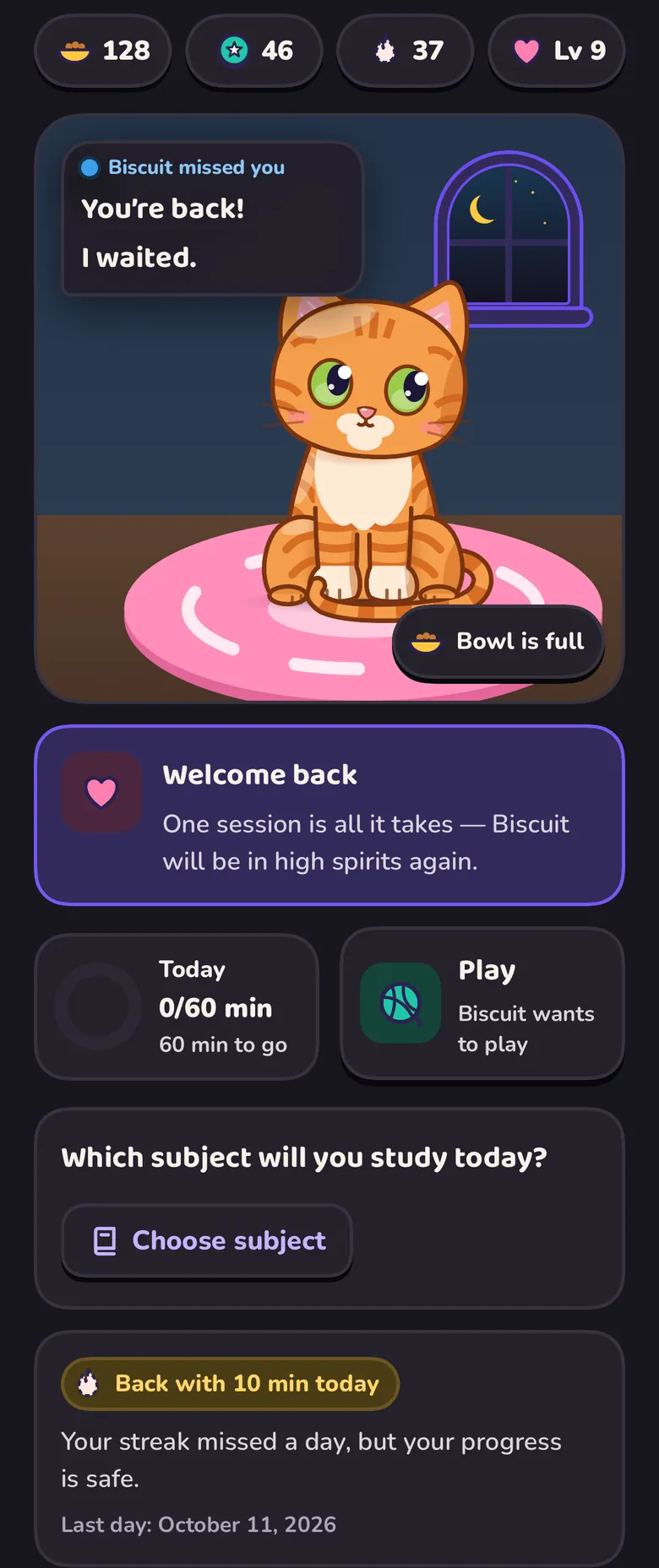
We are the small team behind Study Buddy Cat, a study timer where every focused minute feeds a cat. We write about the study habits we build into the app, drawing on learning research and on what students tell us.
Keep reading
-
 Motivation and habits
How to Get Motivated to Study When You Don't Feel Like It
Motivation usually shows up after you start, not before. Here's how to start anyway: a 10-minute rule, a WOOP worksheet, visible progress and a bad-day plan. -
 Focus
Pomodoro Technique for Studying: A Step-by-Step Guide
What the Pomodoro Technique is, how to run 25/5 cycles, why short breaks help, and how to adjust the timer for math, memorization and reading. -
 Motivation and habits
How to Build a Study Habit: A 30-Day Plan That Sticks
Most habits take longer than 21 days. Use a cue, a tiny daily minimum, the never-miss-twice rule and planned rest days, with a 30-day plan you can copy.
Make your next study session count
Study Buddy Cat turns every verified minute of focus into food for your cat. No account or paywall to start, no ads, and when you take a break, your cat waits for you.