How to Prepare for NEET-UG: Study Plan and Timetable
A NEET-UG plan that works with school and coaching: the 180-question pattern, NCERT-first strategy per subject, a weekly timetable and how to use mocks.

On this page
- NEET-UG at a glance: pattern, marking and what changes
- When to start: a phased NEET plan
- A weekly NEET timetable with school and coaching
- Subject strategy: Biology, Chemistry and Physics
- Past papers, mock tests and the error log
- The last 4 weeks and exam day
- Stress, sleep and rest days
- Where Study Buddy Cat fits
- NEET-UG FAQ
In short
- In the 2026 pattern, NEET-UG has 180 compulsory MCQs in 3 hours (45 Physics, 45 Chemistry, 90 Biology), with +4 for a right answer and −1 for a wrong one, so Biology alone is half your score.
- Build everything on NCERT and chapter-wise PYQs, finish the syllabus about six months before the exam, and spend the last three months on timed full mocks and an error log.
- With school and coaching, 3–4 focused hours of self-study on weekdays plus a Sunday mock is a realistic load; protect sleep and keep one lighter day a week.
- NEET-UG is set to move to computer-based testing from 2027, so take the pattern, dates and rules only from NTA's NEET website and that year's information bulletin.
NEET-UG is the one entrance exam for MBBS, BDS, the AYUSH degrees (BAMS, BSMS, BUMS, BHMS), B.Sc Nursing and BVSc & AH across India, and close to 20 lakh candidates appeared for it in 2026. Your score and All India Rank decide which counselling rounds and colleges you can reach. Ideally, preparation starts with Class 11; most students need at least 12 months of steady work alongside school. With school and coaching, a realistic load is 3–4 hours of focused self-study on weekdays plus a longer Sunday, about 20–25 hours a week. Droppers can manage roughly double.
The plan itself is simple: NCERT first, chapter-wise previous years' questions (PYQs) right after each chapter, the full syllabus done about six months before the exam, and the last three months spent on timed full-length mocks and an honest error log. One caution: the exam is moving to computer-based testing, so take every date, rule and the final pattern from NTA's NEET website (neet.nta.nic.in) and that year's information bulletin, not from Telegram groups or "guess papers".
NEET-UG at a glance: pattern, marking and what changes
NEET-UG is conducted by the National Testing Agency (NTA), an autonomous body under the Ministry of Education. The syllabus is notified by the National Medical Commission (NMC). The exam is held once a year, usually in May. This is the pattern from the information bulletin for the 2026 session:
| Section | Questions | Marks | Syllabus (NMC, 2026) |
|---|---|---|---|
| Physics | 45 | 180 | 20 units, from Physics and Measurement to Electronic Devices and Experimental Skills |
| Chemistry | 45 | 180 | 20 units across physical, inorganic and organic chemistry |
| Biology (Botany and Zoology) | 90 | 360 | 10 units, from Diversity in Living World to Ecology and Environment |
| Total | 180 | 720 | Every question is compulsory |
- Format in 2026: pen and paper, a single shift from 2 to 5 pm. Every question was a multiple-choice question with four options and one correct answer, marked on an OMR sheet.
- Time: 180 minutes for 180 questions, so about one minute per question on average.
- Marking: +4 for a correct answer, −1 for a wrong one, 0 if you leave it blank.
- Languages: 13 mediums: English, Hindi, Assamese, Bengali, Gujarati, Kannada, Malayalam, Marathi, Odia, Punjabi, Tamil, Telugu and Urdu. Hindi and regional-language candidates get a bilingual booklet with English, and the English version is final if a translation is unclear.
- Eligibility basics: at least 17 years old by 31 December of the exam year, no upper age limit, and Class 12 with Physics, Chemistry, Biology/Biotechnology and English. Minimum marks and the qualifying percentile for each category are in the bulletin.
What your NEET score decides
NTA publishes your score and All India Rank; it does not allot seats. The Medical Counselling Committee (MCC) of the DGHS runs counselling for the 15% All India Quota and for central institutions such as AIIMS, JIPMER, ESIC colleges and deemed universities; state authorities run it for state-quota seats, and AACCC for the AYUSH All India Quota. One number worth remembering: every careless mistake costs 5 marks compared with getting it right, so ten silly errors are 50 marks.
When to start: a phased NEET plan
NEET is usually held in May, so count backwards from there. The phases assume you start in Class 11:
| Phase | When | What it looks like |
|---|---|---|
| Foundation | Class 11 to the start of Class 12 | Read each NCERT chapter alongside class; do its exercises and PYQs the same week; write short notes from memory, not copied |
| Completion | 12 → 6 months out | New Class 12 chapters; one daily block on an old Class 11 chapter; a part test every two weeks |
| First full revision | 6 → 3 months out | Whole NCERT Biology again; formula and reaction sheets from memory; one full mock a week |
| Mock phase | 3 months → 4 weeks out | Two full mocks a week, later three; review each the same day; revise from the error log |
| Final weeks | Last 4 weeks | Sharpen, no new books (see below) |
If your Class 12 boards fall in the revision phase, give them their weeks but keep one daily NEET block so nothing goes cold; our board exam timetable guide covers that side.
Starting in Class 12 with less than a year left? Make NCERT plus PYQs the whole plan. As you solve PYQs, note which chapters keep coming up; that is your priority list. Finish the syllabus by about three months out, even roughly. Cut reading, never the mocks.
Taking a drop year? Start with an honest post-mortem: which subject lost the most marks, and was it concept gaps, missed NCERT lines or negative marking? Then run the same phases faster and start full mocks earlier. If you're also weighing engineering, our JEE Main guide shares the Physics and Chemistry base.
A weekly NEET timetable with school and coaching
Most aspirants have school in the morning and coaching or an online batch in the evening, so the timetable is a few fixed blocks you protect: 50 minutes of focus, 10 minutes of break. Shift the times to fit your day:
| Time | What to do |
|---|---|
| 6:15–7:00 | Wake up, water, 25 minutes of Biology recall: yesterday's NCERT pages from memory |
| 7:30–1:30 | School; note one line on anything you didn't understand |
| 1:30–3:00 | Lunch, rest, a 20-minute nap if it helps |
| 3:00–3:50 | Block 1: Physics problems, while you're fresh |
| 4:00–7:00 | Coaching or online lecture |
| 7:00–8:00 | Dinner, family, no screens |
| 8:00–8:50 | Block 2: coaching DPP or Chemistry |
| 9:00–9:50 | Block 3: Biology, NCERT reading followed by closed-book recall |
| 9:50–10:15 | Error log, five quick questions on today's topics, write tomorrow's first task |
| 10:15 | Phone away, lights out |
That's about three hours of self-study plus coaching, and still around eight hours of sleep. Across the week, rotate so Biology gets a block every day:
| Day | Block 1 | Block 2 | Block 3 |
|---|---|---|---|
| Mon, Wed | Physics: today's coaching topic | Chemistry: physical (Mon), inorganic (Wed) | Botany |
| Tue, Thu | Physics: mixed PYQs | Chemistry: organic (Tue), physical (Thu) | Zoology |
| Friday | Physics: weakest chapter | Chemistry: organic | Botany |
| Saturday | Weekly test, all three subjects (90 minutes) | Test review | Zoology |
| Sunday | Full mock in the 2026 slot (2–5 pm); a part test in early phases | Review | Evening off |
In school holidays, and for droppers, the day changes shape: classes in the morning, then 5–7 focused hours in blocks, with a walk or some sport in between. More than that usually turns into rereading; see how many hours to study a day.
Subject strategy: Biology, Chemistry and Physics
Biology: half the paper, built on NCERT
Biology is 90 of 180 questions, 360 of 720 marks. The NMC syllabus follows the Class 11 and 12 curriculum, so NCERT is your main book, not a side book.
- Read NCERT line by line, including examples, diagrams, tables and boxed text. One word from the text can decide between two options.
- Close the book and recall. List key points from memory, draw and label diagrams (heart, nephron, flower, embryo sac), fill in tables, then check.
- Alternate Botany and Zoology so neither half slides; Plant Physiology and Ecology need as much care as Human Physiology.
- Practise Genetics like Physics: crosses and pedigree questions, not just reading.
- Where marks go: look-alike terms, skimmed examples, statements read too fast.
Chemistry: three subjects in one
- Physical chemistry (mole concept, equilibrium, thermodynamics, electrochemistry, kinetics) is numericals: formula sheet from memory, daily problems.
- Inorganic chemistry (periodic trends, p-block, d- and f-block, coordination compounds) is NCERT-based recall: rewrite trends and tables from memory every few days instead of rereading.
- Organic chemistry rests on the general principles: mechanisms first, then reactions and conversions in short daily sets.
- Where marks go: inorganic left to the end, unit and sign errors, similar reagents mixed up.
Physics: practice beats rereading
- Concepts come from class; marks come from solving: DPPs, chapter-wise PYQs, then mixed sets from several chapters, as in the real paper.
- Keep a formula sheet per chapter and rewrite it from memory weekly. Don't skip the Experimental Skills unit; it's in the syllabus.
- Where marks go: long calculations, units, signs, and reading "incorrect" as "correct".
Time and negative marking inside the 180 minutes
- Plan the order in your mocks. Many students start with Biology because it's faster. Test a split such as Biology 60 minutes, Chemistry 50, Physics 60 and 10 for a final check, then adjust.
- Two passes: answer what you're sure of, mark the doubtful ones, come back.
- Guess with a rule, not a mood. With +4 and −1, a guess between two remaining options pays on average; a blind guess across four gains little and makes your score swing. Many students guess only when they can rule out two options. Decide your rule in mocks.
- In a pen-and-paper session, fill the OMR as you go, not in the last ten minutes. If your session is computer-based, practise answering on a screen.
Past papers, mock tests and the error log
Where to find the material. NCERT textbooks are available as PDFs on the NCERT website. After each exam, NTA publishes provisional answer keys with a window to challenge them, shows candidates their scanned OMR sheet and recorded responses, and then releases final keys on neet.nta.nic.in. Previous years' papers are reproduced in PYQ books and coaching modules; check that they match the current syllabus. One good test series is enough; three just triple the reviews you never finish.
Why mocks beat rereading. In a 2013 review of ten common study techniques, John Dunlosky and colleagues rated practice testing and spreading practice over time as the most useful, and rereading and highlighting low. In Henry Roediger and Jeffrey Karpicke's 2006 experiments, students who reread a passage did better on a test minutes later, but those who practised recalling it remembered more a week later. The full method is in our guide to active recall and spaced repetition.
How to review a mock. Review the same day, for at least as long as the mock took. Sort every mistake, including lucky guesses:
| Reason | Example | Fix |
|---|---|---|
| Concept gap | Didn't know how to approach a rotational motion question | Re-learn from NCERT or class notes, then solve 10 PYQs on it |
| NCERT line missed | An example from the Biotechnology chapter | Reread that page, then recall it from memory two days later |
| Calculation or unit slip | Lost a power of ten in a mole problem | Write units at every step for a week |
| Misread the question | Missed "incorrect" in the statement | Underline negatives on the question paper in every mock |
| Time pressure | Rushed the last 20 Physics questions | Change your section order or time split in the next mock |
The last 4 weeks and exam day
- Weeks 4 to 2: three full mocks a week in your exam's time slot (in 2026, 2 to 5 pm), each reviewed the same day; in between, one more pass over NCERT Biology, your sheets and the error log.
- The final week: one or two mocks early on, then light revision only. No new books or test series.
- Logistics: NTA puts out the exam city intimation, the admit card, a dress code and permitted items advisory, and biometric verification instructions. Read each on neet.nta.nic.in and keep printouts ready.
- Body clock: if the paper is in the afternoon, your best focus hours should be there too, not late at night.
On exam day:
- Eat a meal you know suits you and carry only what the admit card and NTA's advisory allow.
- Reach the centre early; security and biometric checks take time.
- Read the instructions calmly, and check the medium and paper details.
- Follow the order and time split you practised, two passes, your guessing rule.
- Afterwards, don't match answers in groups that evening. The provisional key comes from NTA; until then, nothing changes.
Stress, sleep and rest days
The NEET year brings its own pressure: weekly coaching ranks, relatives asking about mock scores, comparisons with cousins, and for droppers the weight of "this year has to work". A mock score is a measurement, not a verdict. Your real benchmark is last month's you: are the same mistakes still in your error log?
Sleep is part of the plan, not a reward after it. A National Sleep Foundation expert panel recommends 8–10 hours a night for teens aged 14–17 and 7–9 hours for those aged 18–25 (Hirshkowitz and colleagues, 2015); more in our guide to sleep and studying. Keep one lighter day or evening each week. It's what keeps you going in month ten.
Some nerves are normal. If stress has been affecting your sleep, appetite or everyday life for weeks, or you're having panic attacks, talk to a parent, teacher, school counsellor or doctor. If you ever have thoughts of harming yourself, tell someone you trust right away. For everyday coping, read our guide to dealing with exam stress.
Where Study Buddy Cat fits
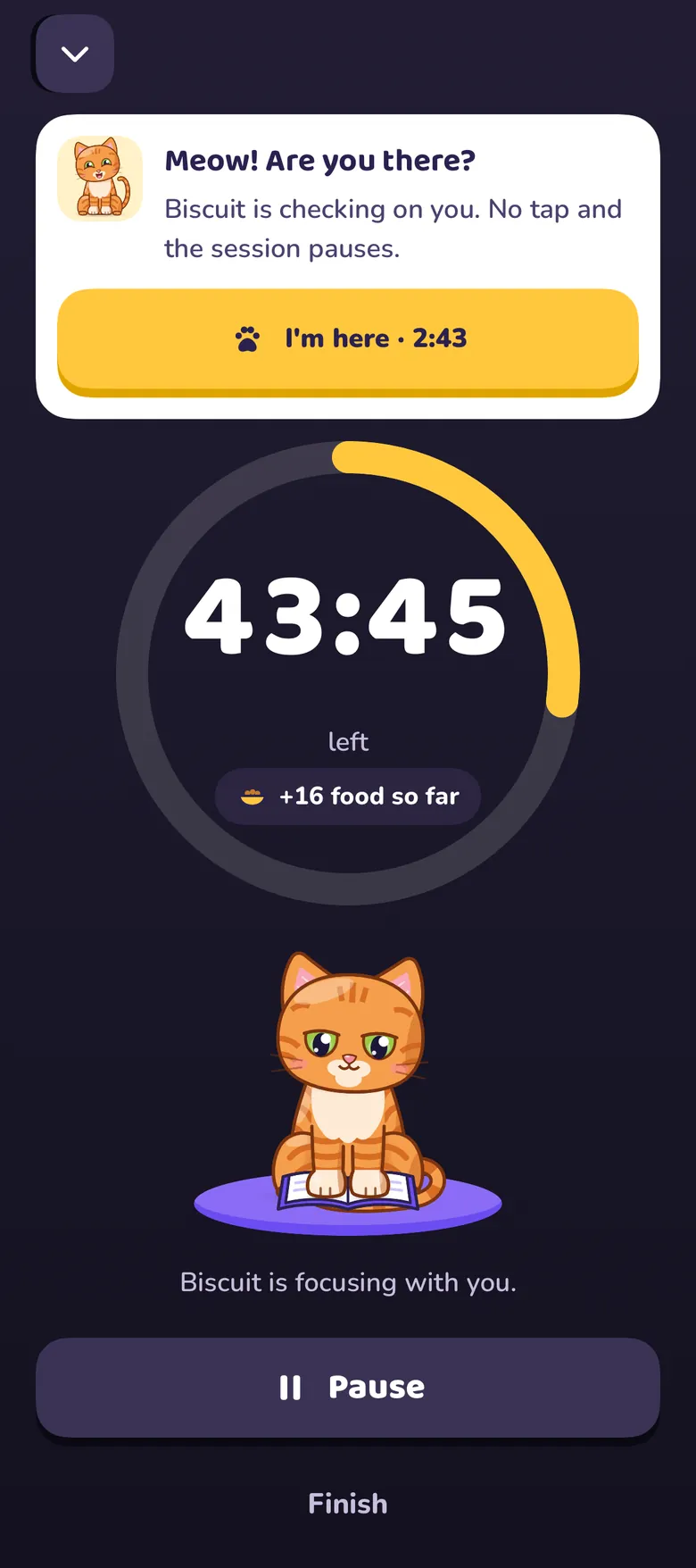
A NEET plan only works if the blocks actually happen. Each Sunday, compare where your focused minutes went with where your marks went: if Physics keeps losing the most marks but gets the fewest minutes, move it to your first block next week.
NEET-UG FAQ
How many hours a day should I study for NEET?
With school and coaching, 3–4 focused hours of self-study on weekdays and a longer Sunday with a mock is a strong routine. Droppers can do 5–7 focused hours on top of classes. Beyond that, extra hours usually turn into rereading.
Is NCERT enough for NEET?
For Biology, NCERT is the core, and knowing it line by line covers most of what you need. For Physics and Chemistry, NCERT builds the concepts, but you also need plenty of practice: PYQs, DPPs and mocks. Add one extra question book only once NCERT is solid.
Can I prepare for NEET without coaching?
Yes, if you replace what coaching gives you: a fixed timetable, regular tests and someone to ask doubts. Use NCERT, a PYQ book, one test series and a fixed weekly mock, and find a teacher or peer group for doubts.
Will NEET 2027 be computer-based?
The Union Education Minister announced in 2026 that NEET-UG would move fully to computer-based testing from 2027. The 2027 information bulletin on neet.nta.nic.in will confirm the format and pattern, so check it as soon as it's out.
Sources and further reading
- National Testing Agency: National Eligibility cum Entrance Test (NEET), official website
- National Testing Agency: Information Bulletin NEET (UG)-2026
- National Medical Commission (UGMEB): Updated syllabus for NEET (UG)-2026
- Medical Counselling Committee (DGHS): Medical Counselling Committee (MCC)
- Dunlosky, J., Rawson, K. A., Marsh, E. J., Nathan, M. J., & Willingham, D. T. (2013). Improving students' learning with effective learning techniques: Promising directions from cognitive and educational psychology. Psychological Science in the Public Interest, 14(1), 4–58.
- Roediger, H. L., & Karpicke, J. D. (2006). Test-enhanced learning: Taking memory tests improves long-term retention. Psychological Science, 17(3), 249–255.
- Hirshkowitz, M., Whiton, K., Albert, S. M., et al. (2015). National Sleep Foundation's sleep time duration recommendations: Methodology and results summary. Sleep Health, 1(1), 40–43.

By the Study Buddy Cat team
We are the small team behind Study Buddy Cat, a study timer where every focused minute feeds a cat. We write about the study habits we build into the app, drawing on learning research and on what students tell us.
Keep reading
-
 Exam guides
How to Prepare for Board Exams: 12-Week CBSE Timetable
A 12-week plan for CBSE Class 10 and 12 boards: NCERT first, sample papers and PYQs, a daily timetable around school and tuition, and balancing JEE or NEET. -
 Exam guides
How to Prepare for JEE Main: Study Plan and Timetable
A JEE Main plan that fits school, coaching and boards: the 75-question pattern, both sessions, subject strategy for PCM, a weekly timetable and mock reviews. -
 Planning and exams
How to Make a Study Schedule You'll Actually Stick To
A six-step method for a weekly study schedule that fits your real life, with school-week and exam-season templates and a 15-minute review checklist.
Make your next study session count
Study Buddy Cat turns every verified minute of focus into food for your cat. No account or paywall to start, no ads, and when you take a break, your cat waits for you.