How Many Hours Should I Study a Day? Realistic Ranges
Realistic daily study ranges for middle school, high school, exam years and college, the signs you've hit diminishing returns, and how to count real focus.

On this page
In short
- There's no single right number: about 1–1.5 focused hours a day in middle school, 1.5–2.5 in high school and 2–3 hours of weekly outside work per college credit hour are starting points, not targets.
- Even top performers rarely sustain more than about four hours a day of their hardest, most deliberate practice, so past a point extra hours add little.
- Count focused minutes and what you produced in them, not hours at the desk, and raise your daily goal only after a week shows you can hit it.
For most students, a realistic amount is about 1–1.5 hours a day in middle school, 1.5–2.5 hours in high school, 2–4 hours on school days during a big exam year, and roughly 2–3 hours of outside work per credit hour per week in college, which comes to around 4–6 hours a day for a full course load. These are ranges for focused work, homework included. They are not hours spent sitting near your books.
The number matters less than what goes into it. Psychologist K. Anders Ericsson and his colleagues found that even elite performers rarely sustain more than about four hours a day of their most demanding, deliberate practice, usually in sessions of an hour or less. Two hours of quizzing yourself with your phone in another room will usually do more than five hours of rereading with notifications on. So the better question is: how many focused minutes, spent on what, and can you keep it up for weeks? If you already study for hours and the results don't match, the fix is rarely more hours. It's better hours.
Is there a right number of hours to study a day?
No. Four things decide your number, and they change from week to week:
- Your goal and deadline. Keeping up with class takes far less time than catching up on a missed month or preparing for a high-stakes test.
- Your level and course load. A seventh grader and a college junior with five courses have very different workloads.
- What you do with the time. In a large review of study techniques, Dunlosky and colleagues (2013) rated practice testing and spreading study out over time as high-utility, and rereading and highlighting as low-utility. An hour of self-testing does more than an hour of rereading the same chapter.
- The rest of your life. School hours, practice, a part-time job, family time and sleep are real limits. A plan that ignores them falls apart by Wednesday.
There is also a ceiling. The roughly four-hour limit from Ericsson's research applies to the hardest kind of work: learning new material, tough problem sets and practice under test conditions. Lighter work like organizing notes or reviewing flashcards you already know can fill extra time, but it doesn't raise the ceiling.
How many hours should you study a day? Realistic ranges
These ranges are rules of thumb for focused study, homework included. Use them to sanity-check your plan, not as a quota.
| Situation | School days | Weekend days | Where the range comes from |
|---|---|---|---|
| Middle school (grades 6–8) | 60–90 min | 0–60 min | The "10-minute rule": about 10 minutes of homework per grade level per night |
| High school (grades 9–12) | 1.5–2.5 h | 1–2 h | The same rule (90–120 min), plus review before tests |
| Exam year (SAT/ACT, AP exams, finals) | 2–4 h | 3–5 h in blocks, one lighter day | Homework plus exam prep, kept under the ~4 h ceiling for hard work |
| College, full-time (about 15 credits) | 4–6 h, spread over the week | Similar or lighter | 2–3 hours of outside work per credit hour per week (30–45 h a week) |
| Full-time prep for one big exam | 6–8 h at the desk, 4–6 h of it focused | One rest day a week | No classes, but the same ceiling for the hardest work |
How to read the table:
- The low end is enough to keep up. The high end is for catching up, heavy courses or the last weeks before a big exam.
- If you're far below the low end, add 15 minutes a day, not two hours. Big jumps rarely last.
- If you're regularly above the high end and still behind, the problem is probably your method or course load, not your effort. Talk to a teacher, a school counselor or your professor.
Middle and high school
The "10-minute rule" is a widely cited US guideline associated with homework researcher Harris Cooper: roughly 10 minutes of homework per grade level per night, so about 60 minutes in sixth grade and 120 minutes by twelfth. In a 2006 review of homework research, Cooper and colleagues found that the link between homework and achievement was stronger for students in grades 7–12 than for younger students. Time pays off better as you get older, but never without limit: a calm, consistent hour beats a three-hour evening that ends in tears.
College: the credit-hour rule
Many US colleges tell students to plan about 2–3 hours of outside work per week for every credit hour, and the standard definition of a credit hour assumes roughly one hour in class plus about two hours of work outside it each week. To find your number:
- Multiply your credits by 2 for typical courses and by 3 for demanding ones. A 15-credit semester comes to roughly 30–45 hours a week.
- Divide by the days you actually study. Spread over seven days, that's about 4–6.5 hours a day; with one rest day, about 5–7.5.
- Adjust after two or three weeks based on quiz grades and how prepared you feel. A discussion-based elective may need far less; organic chemistry may need the full amount.
Much of that time isn't peak-intensity work. Readings, drafts, lab write-ups and group meetings all count. Put the hardest work into your first focused blocks of the day.
Why more hours stop paying off
Studying more helps up to a point, and then the returns shrink. Four reasons:
- Deep focus runs out. Because of that ceiling, the sixth and seventh hour of a long day are usually lower-quality than the first.
- Spreading beats piling. Cepeda and colleagues (2006) reviewed hundreds of experiments on distributed practice: spacing study sessions apart led to better long-term memory than packing the same total time into one session. One hour a day for five days usually beats five hours on Sunday.
- Sleep is part of studying. The National Sleep Foundation's recommendations (Hirshkowitz et al., 2015) are 8–10 hours for teens aged 14–17 and 7–9 hours for young adults aged 18–25. Hours taken from sleep are borrowed against tomorrow's memory and focus. More on that in how sleep affects studying.
- Attention needs resets. In a lab task that required sustained attention, Ariga and Lleras (2011) found that brief, rare breaks from the task helped prevent the usual drop in performance over time. Good study breaks are what make the next block worth having.
Signs you've hit diminishing returns
You can be at your desk for a long time after you've stopped learning. Watch for these:
- You read the same paragraph twice and can't say what it said.
- Problems that took five minutes earlier now take fifteen, or you make careless mistakes you normally wouldn't.
- You reach for your phone, the fridge or a new tab every few minutes.
- You drift to easy tasks, like recopying notes or recoloring your planner, without deciding to.
- Your eyes feel heavy, your head hurts, or you're snapping at people.
- When you close the book, you can't recall anything specific from the last block.
- Studying late keeps pushing back your bedtime, and mornings feel foggy.
A quick check after each block: close your notes and write down three things you just learned, or solve one problem without looking. If you can't, another hour of the same thing probably won't help either.
Measure focused minutes, not hours at the desk
"I studied for three hours" often means "I was in my room with my books for three hours." Subtract messages, snacks, hunting for the right file and staring at the wall, and the real total can be a lot smaller. You can't plan well with a number you're guessing.
Three habits fix that:
- Run a timer only while you're working. Start it when you begin the task, and pause it the moment you pick up your phone, start chatting or wander off. Block-based timers help here; the common lengths are compared in focus timer methods.
- Write down output, not just minutes. Problems solved, practice questions written, pages turned into flashcards, a section of an essay drafted. Output tells you whether the minutes were useful.
- Compare focused time with desk time. At the end of the day, divide focused minutes by the time you were at your desk. That's your focus ratio, and raising it is often easier than adding hours.
Here's what one evening might look like in a simple log (an invented example):
| Block | Subject | Time at desk | Focused minutes | Output |
|---|---|---|---|---|
| 4:00–4:50 | Algebra | 50 min | 40 | 12 problems, redid the 2 I got wrong |
| 5:00–5:45 | History | 45 min | 25 | Read 6 pages, wrote 8 quiz questions |
| 8:30–9:30 | Chemistry | 60 min | 30 | Phone kept buzzing, reviewed 20 flashcards |
| Total | 2 h 35 min | 95 min |
That evening felt like "about three hours," but it held 95 focused minutes, and the late chemistry block was the weakest. The useful change isn't another hour. It's moving chemistry earlier and putting the phone in another room.
How to find your own daily number
Your right number is the one you can hit on most study days for months, with enough sleep, and that shows up in your results. Here's how to find it:
- Measure one normal week. Don't change anything yet. Log focused minutes each day; your median day is your real baseline.
- Set a goal just above it. If your median is 70 minutes, aim for 80–90, not 180.
- Split it into blocks. Two to four blocks of 25–50 minutes with breaks in between, hardest subject first.
- Raise it slowly. Add 10–15 minutes a week only if you hit the goal on most study days and still sleep enough.
- Plan a rest day. One free or lighter day a week keeps the routine going for months instead of weeks.
- Review weekly. Compare your minutes with results like quiz scores and practice tests, and move time toward the subjects that need it.
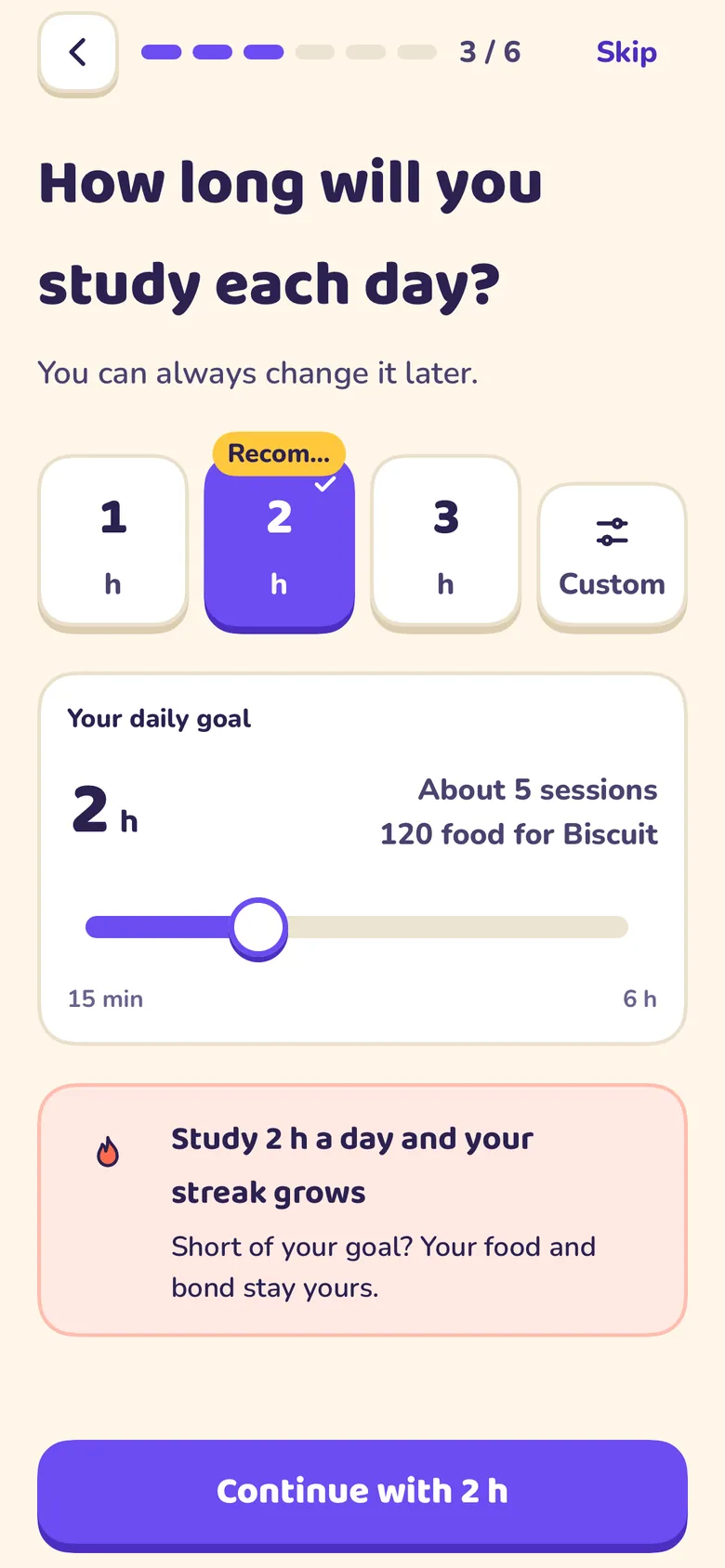
What a realistic day can look like
- High school, regular week: two 40-minute blocks after school (homework first, then review for the next test) and 15 minutes of flashcards after dinner. About 1.5 focused hours.
- Exam-year Saturday: three 50-minute blocks in the morning (one timed practice section, reviewing its mistakes, one weak topic), the afternoon off, and a 30-minute light review in the evening. About 3 focused hours.
- College weekday: two focused blocks between classes for readings (writing questions as you go), a 90-minute problem set in the evening with a short break, and 10 minutes planning tomorrow. About 3–3.5 hours, more on days with fewer classes.
To turn your daily number into a weekly timetable with subjects, review days and a buffer for surprises, follow the steps in how to make a study schedule. More guides on planning are in the planning section of the blog.
Frequently asked questions
Is 2 hours of studying a day enough?
For most high school students in a normal week, two focused hours including homework is solid. For a full college course load, it's usually on the low side unless your classes are light. Your grades and practice tests are the real check.
Can you study 10 or 12 hours a day?
You can sit at a desk that long, but you can't keep your best focus that long; even elite performers rarely sustain more than about four hours a day of deliberate practice. Long days only work if much of the time is lighter review, with real breaks and full nights of sleep.
Do breaks count toward study time?
Count only focused minutes. Breaks don't go in the total, but they're what make those minutes possible, so plan them in rather than skipping them.
Should I study every day, including weekends?
Short, regular sessions usually beat occasional marathons, because spacing helps memory. A planned rest day each week is part of a good plan, not a lapse in it.
Sources and further reading
- Ericsson, K. A., Krampe, R. T., & Tesch-Römer, C. (1993). The role of deliberate practice in the acquisition of expert performance. Psychological Review, 100(3), 363–406.
- Cooper, H., Robinson, J. C., & Patall, E. A. (2006). Does homework improve academic achievement? A synthesis of research, 1987–2003. Review of Educational Research, 76(1), 1–62.
- Dunlosky, J., Rawson, K. A., Marsh, E. J., Nathan, M. J., & Willingham, D. T. (2013). Improving students' learning with effective learning techniques: Promising directions from cognitive and educational psychology. Psychological Science in the Public Interest, 14(1), 4–58.
- Cepeda, N. J., Pashler, H., Vul, E., Wixted, J. T., & Rohrer, D. (2006). Distributed practice in verbal recall tasks: A review and quantitative synthesis. Psychological Bulletin, 132(3), 354–380.
- Ariga, A., & Lleras, A. (2011). Brief and rare mental "breaks" keep you focused: Deactivation and reactivation of task goals preempt vigilance decrements. Cognition, 118(3), 439–443.
- Hirshkowitz, M., Whiton, K., Albert, S. M., et al. (2015). National Sleep Foundation's sleep time duration recommendations: Methodology and results summary. Sleep Health, 1(1), 40–43.

By the Study Buddy Cat team
We are the small team behind Study Buddy Cat, a study timer where every focused minute feeds a cat. We write about the study habits we build into the app, drawing on learning research and on what students tell us.
Keep reading
-
 Planning and exams
How to Make a Study Schedule You'll Actually Stick To
A six-step method for a weekly study schedule that fits your real life, with school-week and exam-season templates and a 15-minute review checklist. -
 Study techniques
Pomodoro vs 52/17 vs 90-Minute Blocks: Which Study Timer Works?
Pomodoro, 50/10, 52/17, 90-minute blocks or flowtime? Compare work and break lengths, see what the evidence really says and pick the method that fits you. -
 Balance and wellbeing
Study Break Ideas: What to Do and How Long Breaks Should Be
How long should study breaks be, and what should you do in them? A break-length table, 5- to 30-minute ideas, breaks to skip and how to get back to work.

Make your next study session count
Study Buddy Cat turns every verified minute of focus into food for your cat. No account or paywall to start, no ads, and when you take a break, your cat waits for you.