How to Study for the IB Diploma: Revision Plan and Timetable
Two years of IB in one plan: how the 45 points work, when to fit in IAs and the EE, a weekly timetable, subject tips, past papers and the final four weeks.

On this page
In short
- The IB Diploma is scored out of 45 (up to 7 points per subject plus 3 from TOK and the Extended Essay), and the diploma needs at least 24 points, the core and a few minimum conditions.
- IAs, the 4,000-word Extended Essay and the TOK essay land in DP2, so plan them in DP1 and keep one revision block a day even in coursework weeks.
- Aim for 2–3 focused hours on school days plus a longer weekend session, spent on past-paper questions and recall rather than rereading.
- Exams run in May or November depending on your school, and maths changes for first exams in 2029.
The IB Diploma Programme (DP) is two years of six subjects plus the core, ending in a score out of 45 that universities read alongside your grades in particular subjects. Each subject is graded from 7 down to 1, and Theory of Knowledge (TOK) and the Extended Essay (EE) together add up to 3 points. You need at least 24 points, the core completed and a few minimum conditions met to be awarded the diploma; university offers usually ask for more, often with minimum grades in named Higher Level (HL) subjects.
The catch is timing. Internal assessments (IAs), the EE and the TOK essay pile up in DP2, exactly when you should be revising, so start revising in the first term of DP1, not after mocks. Alongside school, CAS and coursework, a realistic load is 2–3 focused hours on school days plus one longer weekend session, about 12–15 hours a week in DP1 and 15–20 in the spring of DP2, spent on exam-style questions and testing yourself rather than rereading.
The IB Diploma at a glance
The curriculum has six subject groups (studies in language and literature, language acquisition, individuals and societies, sciences, mathematics, and the arts) plus the DP core. You take one subject from each group, although you can swap the arts for a second science, individuals and societies subject or language. Three or four subjects are taken at HL and the rest at Standard Level (SL). HL courses are built around 240 teaching hours, SL courses around 150.
| Part | What it is | How it counts |
|---|---|---|
| Six subjects | 3–4 at HL, the rest at SL | Each graded 7 (top) to 1, so up to 42 points |
| Final exams | Usually two or three papers per subject at the end of DP2 | The main part of most subject grades |
| Internal assessment (IA) | Coursework such as a maths exploration or science investigation, marked by your teacher and moderated by the IB | Roughly 20–50% of a subject grade |
| Theory of knowledge | An exhibition and a 1,600-word essay | With the EE, up to 3 points |
| Extended essay | Independent research ending in a 4,000-word paper | With TOK, up to 3 points |
| CAS | Creativity, activity, service | No points, but required for the diploma |
That makes 45 the maximum. Under the current rules, 24 points is not enough on its own: an E in TOK or the EE, a 1 in any subject, too many grades of 2 or 3, fewer than 12 points across your HL subjects or 9 across SL, or unfinished CAS can each stop the diploma. Your IB coordinator has the full conditions for your session.
There are two exam sessions a year: May, mostly for Northern Hemisphere schools, and November, mostly for the Southern Hemisphere. The IB is also adding digital exams alongside paper ones, starting with a few subjects in 2026, so ask which format your papers will use.
What the papers look like: two examples
Each subject has its own assessment model in its subject guide. Two examples, as currently published:
| Subject | SL | HL |
|---|---|---|
| Math AA | Paper 1, no calculator (1.5 h, 40%); Paper 2, calculator allowed (1.5 h, 40%); exploration (20%) | Paper 1 (2 h, 30%); Paper 2 (2 h, 30%); Paper 3, two long problem-solving questions (1 h, 20%); exploration (20%) |
| Chemistry (first exams 2025) | Paper 1: 1A multiple choice, 1B data and experimental questions (1.5 h, 36%); Paper 2, short and extended answers (1.5 h, 44%); scientific investigation (20%) | Paper 1 (2 h, 36%); Paper 2 (2.5 h, 44%); scientific investigation (20%) |
English A: Literature works differently: one exam paper analyses an unseen literary passage, the other compares two works you've studied, there's an oral on two works, and HL students also write a 1,200–1,500-word essay.
When to start: a two-year IB plan
Count back from your exam session. This plan assumes May exams; if your school sits in November, shift each phase by about six months.
| Phase | When | What to do |
|---|---|---|
| Set up | First term of DP1 | Turn each lesson into questions; recall last week's topics once a week; try past-paper questions on topics you've finished; get your school's internal deadlines for IAs, the EE and TOK |
| Build | Rest of DP1 | Topic tests from past papers; choose your EE subject and research question early; start IA ideas so data collection isn't rushed |
| Summer | Between DP1 and DP2 | EE research and a full draft if your school allows it; one short recall session per subject each week |
| Coursework term | First term of DP2 | Finish IAs, the EE and the TOK essay to your school's deadlines; keep at least one daily block for exam revision; school mocks often come at the end |
| Paper practice | After mocks until April | Timed papers component by component, HL subjects first, all mistakes in an error log |
| Final weeks | Last 4 weeks | Full papers under exam conditions and sharpening (see below) |
Starting early works because of spacing: in a 2006 review of distributed-practice research, Nicholas Cepeda and colleagues found that spreading study sessions out beats cramming the same time together for long-term retention. You need DP1 content almost two years later, so that matters. The method is in our guide to active recall and spaced repetition.
Already in DP2 and behind? Don't redo DP1. Mark every topic green, yellow or red and spend your blocks on past-paper questions for red topics in your HL subjects first. Finish coursework to deadline, but never let it take every block of the day.
Still in Year 11 and deciding? Our guides to IGCSE revision and Cambridge A Levels cover the other route.
A weekly IB timetable that fits school, CAS and coursework
Most IB days are long, so the timetable is three protected blocks of 50 minutes of focus and 10 minutes of break, not a whole evening of "studying". Adjust the times to your school day:
| Time | What to do |
|---|---|
| 7:30–7:50 | Flashcards or yesterday's topic from memory |
| 8:00–15:30 | School; jot down anything you didn't follow |
| 15:30–17:00 | CAS, sport or a real break |
| 17:00–17:50 | Block 1: an HL subject, exam-style questions |
| 18:00–18:50 | Block 2: coursework (IA, EE or TOK) or a second subject |
| 18:50–19:45 | Dinner, no screens |
| 19:45–20:35 | Block 3: recall for an SL subject or language |
| 20:35–21:00 | Error log, then write tomorrow's first task |
Across the week, rotate so every HL subject gets at least three blocks. Here's an example for the STEM combination (HL Math AA, Physics and Chemistry; SL English A, Spanish B and Economics):
| Day | Block 1 | Block 2 | Block 3 |
|---|---|---|---|
| Monday | Math AA problems | IA work | Spanish B vocabulary and a short writing task |
| Tuesday | Physics problems | Economics diagrams and definitions | English A: analyse an unseen passage in 30 minutes |
| Wednesday | Chemistry problems | IA or EE work | Math AA recall: last month's topics |
| Thursday | Math AA mixed questions | Physics data questions | Economics case study |
| Friday | Chemistry recall | TOK reading or EE notes | Off |
| Saturday | One timed past-paper component, then marking (2 blocks) | Weakest subject | Off |
| Sunday | Plan the week; 1–2 blocks of coursework | Off | Off |
In coursework weeks, give the IA or EE two blocks a day but keep one for exam subjects; coursework expands to fill whatever time you give it. In holidays, 4–5 focused hours a day is plenty, with evenings off. More usually turns into rereading; see how many hours to study a day.
Strategy by subject and track
Use the group that matches your combination.
STEM: Math AA, Physics, Chemistry, Economics
- Math AA: Paper 1 allows no calculator, so practise algebra, exact values and sketching by hand every week. Know your graphic display calculator well enough that it saves time on Paper 2. HL students should start Paper 3 practice early in DP2.
- Physics and Chemistry: Paper 1A rewards broad, fast recall, so do mixed sets from all topics; practise Paper 1B data and experimental questions weekly, not just in spring.
- Where marks go: missing units and significant figures, "show that" answers without every step, vague definitions instead of the markscheme's wording.
Medicine: Biology, Chemistry, Psychology
- Biology: make question cards for every definition, draw and label diagrams from memory, and do data-based questions as often as recall.
- Psychology: for each study, know the aim, method, results and one strength and limitation, then practise tying it to the exact question.
- Where marks go: describing instead of answering, and ignoring the command term (describe, explain, evaluate).
Business: Economics, Business Management, Math AI
- Economics: draw and label every diagram from memory, keep a bank of real-world examples, and practise evaluation.
- Business Management: apply tools to the case material under time; generic answers that fit any company score poorly.
- Math AI: much of it is modelling and statistics with technology, so practise choosing the right tool for a context.
- Where marks go: unlabelled diagrams, examples that don't fit, conclusions without a judgement.
Humanities: English A Literature, History, Global Politics, ESS
- English A Literature: time yourself analysing unseen passages, and prepare each studied work with short quotations and themes you can compare.
- History: write essay plans from memory in 10 minutes with a clear argument and evidence.
- Global Politics and ESS: keep detailed case studies; specific evidence separates the top bands.
- Where marks go: narrating events or retelling plots instead of arguing a line.
Languages and the core: B languages, TOK, EE
- Spanish B or French B: vocabulary daily in short sessions, one timed writing task a week, speaking practice before the oral.
- TOK: practise unpacking prescribed titles and backing claims with real examples from your subjects.
- EE: a narrow research question makes 4,000 words manageable; set mini-deadlines between supervisor meetings.
IB past papers, markschemes and mocks
Past papers are the most direct preparation you have. Ask your teachers for past papers and markschemes that match your current subject guide, do them component by component, and mark them with the markscheme, not with a feeling. In a 2013 review of ten study techniques, John Dunlosky and colleagues rated practice testing and spreading practice over time as the most useful, and rereading and highlighting low. In Henry Roediger and Jeffrey Karpicke's 2006 experiments, students who reread a passage did better on a test minutes later, but those who practised recalling it remembered more a week later.
Review every paper the same day and sort each lost mark:
| Reason | Example | Fix |
|---|---|---|
| Content gap | Couldn't start an equilibrium question | Relearn the topic, then five past-paper questions on it |
| Markscheme wording | Right idea, missing the key term | Rewrite the answer in the markscheme's words |
| Command term | Described when asked to evaluate | Underline the command term before writing |
| Timing | Rushed the last long question | Redo that component with a stricter time limit |
The last 4 weeks and exam day
By now your coursework should be submitted, so the final month is for exam papers only.
- Weeks 4 to 2: one or two timed components a day, reviewed the same day, with your weakest HL subject getting the most. In between, go through your question cards and error log.
- Plan around the timetable. A subject's papers are often on the same or consecutive days, so prepare them as a pair: the evening before Paper 1 is for Paper 1 and Paper 2 together, not a new subject.
- The final week: light review only, no new material, normal bedtime. Check your exam timetable and what you can bring with your coordinator.
On exam day:
- Eat a breakfast you know suits you and bring water and a spare pen.
- Use reading time, if your paper has it, to plan the order you'll answer in.
- Answer what you know first, then come back to the hard questions.
- Afterwards, let the paper go. Comparing answers changes nothing and costs focus for the next one.
Results are released on the IB candidate website, using a personal code and PIN from your coordinator. Before results come out, you can ask for them to be sent to up to six universities free of charge, and if a grade looks wrong, your school can submit an enquiry upon results.
Stress, sleep and rest days
The IB has its own pressure points: three IAs due in the same fortnight, predicted grades, CAS on top of everything and endless comparing of points totals. A mock grade is a measurement, not a prediction; the useful question is whether the same mistakes are still in your error log.
Sleep is part of the plan. A National Sleep Foundation expert panel recommends 8–10 hours a night for teens aged 14–17 and 7–9 hours for those aged 18–25 (Hirshkowitz and colleagues, 2015). Late-night coursework sessions are where it usually goes, so cap them; more in our guide to sleep and studying. Keep one evening a week completely free.
If stress has been affecting your sleep, appetite or everyday life for weeks, or you're having panic attacks, talk to your school counsellor, IB coordinator, a parent or a doctor. For everyday coping, read our guide to dealing with exam stress.
Where Study Buddy Cat fits
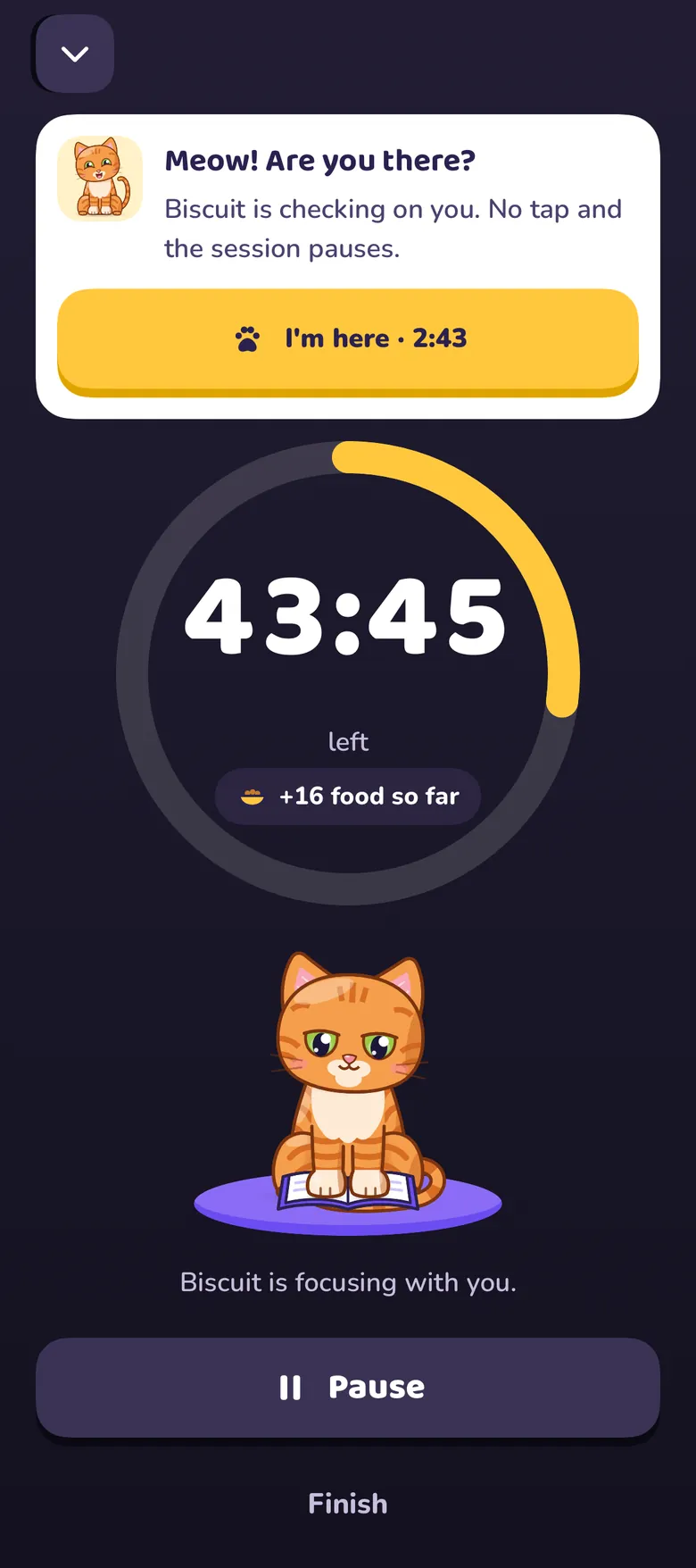
The biggest risk in the IB is coursework quietly eating your revision time. Each Sunday, check where your focused minutes went: if the EE took most of them and your weakest HL subject got almost none, fix next week's first blocks.
IB Diploma FAQ
How many hours a day should I study for the IB?
On school days, 2–3 focused hours outside lessons plus a longer weekend session is a strong routine. In the spring of DP2 and in holidays, 4–5 hours a day is plenty.
When should I start revising for IB exams?
In the first term of DP1. Weekly recall and past-paper questions on finished topics from the start mean DP2 is for practising papers, not relearning a year of content while coursework is due.
Can you fail the IB Diploma with more than 24 points?
Yes. Even with 24 points or more, the diploma is not awarded if a failing condition applies, such as an E in TOK or the EE, a 1 in any subject, too few HL or SL points, or unfinished CAS. Check the full conditions for your session with your coordinator.
Can I retake IB exams?
Yes. The IB has a retake process in a later session; your coordinator makes the entry and can tell you which components carry over. If you retake, put your time into the one or two subjects closest to the next grade or to a failing condition.
Sources and further reading
- International Baccalaureate: DP curriculum
- International Baccalaureate: Understanding DP assessment
- International Baccalaureate: DP mathematics
- International Baccalaureate: Chemistry subject brief, first assessment 2025
- Dunlosky, J., Rawson, K. A., Marsh, E. J., Nathan, M. J., & Willingham, D. T. (2013). Improving students' learning with effective learning techniques: Promising directions from cognitive and educational psychology. Psychological Science in the Public Interest, 14(1), 4–58.
- Roediger, H. L., & Karpicke, J. D. (2006). Test-enhanced learning: Taking memory tests improves long-term retention. Psychological Science, 17(3), 249–255.
- Cepeda, N. J., Pashler, H., Vul, E., Wixted, J. T., & Rohrer, D. (2006). Distributed practice in verbal recall tasks: A review and quantitative synthesis. Psychological Bulletin, 132(3), 354–380.
- Hirshkowitz, M., Whiton, K., Albert, S. M., et al. (2015). National Sleep Foundation's sleep time duration recommendations: Methodology and results summary. Sleep Health, 1(1), 40–43.

By the Study Buddy Cat team
We are the small team behind Study Buddy Cat, a study timer where every focused minute feeds a cat. We write about the study habits we build into the app, drawing on learning research and on what students tell us.
Keep reading
-
 Exam guides
How to Study for Cambridge A Levels: Revision Plan and Timetable
Cambridge International AS & A Level made manageable: staged or linear routes, grades, a weekly timetable, subject tips, past papers and the final four weeks. -
 Exam guides
How to Revise for IGCSE: A Two-Year Plan and Timetable
An IGCSE plan for Year 10 and Year 11: Core or Extended, A* to G and 9 to 1 grades, a weekly revision timetable, subject tips, past papers and exam season. -
 Planning and exams
How to Make a Study Schedule You'll Actually Stick To
A six-step method for a weekly study schedule that fits your real life, with school-week and exam-season templates and a 15-minute review checklist.

Make your next study session count
Study Buddy Cat turns every verified minute of focus into food for your cat. No account or paywall to start, no ads, and when you take a break, your cat waits for you.