How to Study for Cambridge A Levels: Revision Plan and Timetable
Cambridge International AS & A Level made manageable: staged or linear routes, grades, a weekly timetable, subject tips, past papers and the final four weeks.

On this page
- Cambridge AS & A Level at a glance
- When to start: a two-year A Level plan
- A weekly A Level timetable with school and tuition
- Strategy by subject combination
- Past papers, mark schemes and grade thresholds
- The last 4 weeks and exam day
- Stress, sleep and rest days
- Where Study Buddy Cat fits
- Cambridge A Level FAQ
In short
- Cambridge International A Levels are graded A* to E and AS Levels a to e; the AS covers about half the A Level, and exams run in June and November with results in August and January.
- Agree your route with your school early (staged, with AS exams after year one, or linear, with everything at the end), because it changes what you revise and when.
- Two to three focused hours on school days plus a longer weekend session, spent on past-paper questions marked against the mark scheme, beats hours of rereading.
- Pearson Edexcel International A Levels are modular, with unit exams in January, June and October for most subjects, so plan revision unit by unit.
Cambridge International AS & A Levels are the pre-university courses taken in Cambridge schools around the world, and for most students the grades in three or four subjects decide which university courses they can get into, at home or abroad. An A Level typically takes two years with exams at the end, and is graded from A* down to E. The AS Level covers about half of the content, is usually examined after one year and is graded from a to e. Exams are held in June and November, with results in August and January.
Start revising in the first term of your AS year, not after your mocks: everything from year one comes back in your final papers. With school and any evening tuition, a realistic load is 2–3 focused hours of your own study on school days plus a longer weekend session, about 12–15 hours a week in the AS year and 15–20 in the spring of your final year. Spend it on past-paper questions and testing yourself, not on rereading notes.
Cambridge AS & A Level at a glance
| AS Level | A Level | |
|---|---|---|
| Content | About half of the A Level syllabus | The AS content plus the rest, often called "A2" |
| Typical length | Usually one year (some schools teach it over two) | Typically two years, exams at the end |
| Grades | a to e (lower case) | A* to E |
| Below the lowest grade | Ungraded | You may be awarded a compensatory AS Level |
| Exam series | June and November | June and November |
| Results | August (June series), January (November series) | Same |
Cambridge offers 55 subjects at this level, and schools can combine them almost freely; India also has a March series. Grade thresholds, the raw marks needed for each grade, are set for each syllabus in each series and published on the Cambridge International website, so a percentage that meant an A last year is not a fixed target.
Staged, linear or best of both: know your route
"A2" is not a qualification on its own. To get an A Level, your school enters you through one of these routes:
| Route | What happens | What it means for revision |
|---|---|---|
| Staged | AS papers in one series, A2 papers in a later one; the AS result is carried forward | Two exam seasons; year-one content must still be fresh for A2 papers that build on it |
| Linear | All AS and A2 papers in the same series at the end | One big season, so year-one topics need regular spaced review |
| Best of both | AS and A2 papers together, with an earlier AS result as a fallback | Your best valid AS result is used, which takes some pressure off the resit |
Two rules matter for planning. An AS result can only count towards an A Level within 13 months, and it can be carried forward twice in that window: an AS from June can count in that November and/or the following June. And staged assessment isn't offered in every subject, for example where there is no separate AS syllabus, so check each subject with your exams officer.
Taking Pearson Edexcel International A Levels instead?
Edexcel IALs are modular. You sit unit exams when you're ready or all together at the end, results are banked until you cash in, and you can resit individual units to improve your grade. Most subjects have exams in January, June and October, and the AS can be a qualification on its own. Mathematics, for example, is six units: Pure 1–4 plus two applied units, each a 1 hour 30 minute paper out of 75 marks. Plan revision unit by unit, and decide which units go in which series before the year starts.
When to start: a two-year A Level plan
This plan assumes June exams; for November, move each phase about five months later.
| Phase | When | What to do |
|---|---|---|
| Foundations | First term of the AS year | Turn each lesson into questions; weekly recall of older topics; past-paper questions by topic as soon as you finish one |
| Topic practice | Rest of the AS year | Topical past papers; a short error log per subject; first timed papers |
| AS exams (staged route) | Late spring of year one | Full AS papers under time for 6–8 weeks |
| New content | First term of the A2 year | New topics in class; one block a week reviewing AS topics in every subject |
| Full papers | After school mocks | Timed past papers, reviewed the same day; weakest paper first |
| Final weeks | Last 4 weeks | Sharpening (see below) |
Spacing is why the early start pays off. In a 2013 review of ten study techniques, John Dunlosky and colleagues rated practice testing and spreading practice over time as the two most useful, and rereading, highlighting and summarising as usually done as low. The full method is in our guide to active recall and spaced repetition.
Starting late? List every topic in each syllabus, mark it green, yellow or red, and give your blocks to past-paper questions on red topics in your most important subject first.
A weekly A Level timetable with school and tuition
Many A Level students have school in the day and tuition or an academy in some evenings. Treat tuition as class time: the timetable below is the self-study around it, in blocks of 50 minutes of focus and 10 minutes of break.
| Time | What to do |
|---|---|
| 7:15–7:35 | Flashcards: yesterday's definitions and formulas from memory |
| 8:00–14:30 | School; note one line on anything you didn't follow |
| 14:30–16:00 | Lunch, rest, a real break |
| 16:00–16:50 | Block 1: the hardest subject, past-paper questions |
| 17:00–19:00 | Tuition, or two more blocks on tuition-free days |
| 19:00–20:00 | Dinner, no screens |
| 20:00–20:50 | Block 2: a second subject, recall or mixed questions |
| 20:50–21:15 | Error log; write tomorrow's first task |
Across the week, rotate so every subject gets at least three blocks. An example for the Pre-medical combination:
| Day | Block 1 | Block 2 | Block 3 (no tuition) |
|---|---|---|---|
| Monday | Chemistry problems | Biology recall | Physics topic questions |
| Tuesday | Physics problems | Chemistry: organic reactions from memory | Biology diagrams |
| Wednesday | Biology data questions | Physics recall | Chemistry mixed questions |
| Thursday | Chemistry calculations | Biology recall | Weakest topic |
| Friday | Physics mixed questions | Light review | Off |
| Saturday | One timed past paper and marking (2 blocks) | Error-log redo | Off |
| Sunday | Plan the week; one light recall block | Off | Off |
In school holidays, 4–5 focused hours a day is plenty. More than that usually turns into rereading; see how many hours to study a day.
Strategy by subject combination
Pre-medical: Biology, Chemistry, Physics
- Biology: learn definitions in the exact wording mark schemes reward, draw diagrams from memory, and practise data and graph questions every week.
- Chemistry: keep separate sheets for calculations, organic reaction pathways and inorganic trends, and rewrite each from memory every few days.
- Physics: concepts come from class; marks come from problems, so do topical questions after every lesson and mixed sets later.
- Where marks go: vague definitions, missing units, and practical questions answered from theory instead of the method actually described.
Pre-engineering: Maths, Physics, Chemistry
- Maths: do practice in mixed order once you've learnt a topic. In a 2007 study by Doug Rohrer and Kelli Taylor, students who practised shuffled maths problems did worse during practice but clearly better on a test a week later than students who practised one type at a time.
- Physics and Chemistry: as above, with extra time on longer structured questions.
- Where marks go: skipped steps, so the method marks vanish when the final answer is wrong; rounding too early.
Computing: Maths, Physics, Computer Science
- Computer Science: write and trace code and pseudocode by hand under time, not only on a computer; theory topics need question cards like any other subject.
- Where marks go: algorithms without a trace table, answers that describe what code does without explaining why.
Business: Economics, Business, Accounting, Maths
- Economics: draw and label every diagram from memory and practise essays with a final judgement.
- Business: apply each answer to the case, not to businesses in general.
- Accounting: speed and accuracy come from timed practice; redo every wrong statement from scratch.
- Where marks go: unlabelled diagrams, unapplied answers, and arithmetic slips in long accounts.
In every subject, read the command word first. "State" wants a short answer, "explain" wants reasons, "discuss" or "evaluate" wants both sides and a conclusion.
Past papers, mark schemes and grade thresholds
Past papers are the most direct preparation you have. Use papers that match the syllabus for your exam year, mark them with the mark scheme, and ask your teachers for examiner reports where they have them: they show the mistakes that cost candidates marks.
Why it works: in a 2011 experiment by Jeffrey Karpicke and Janell Blunt, students who practised recalling a text remembered more a week later than students who built detailed concept maps from it. Writing an answer from memory and checking it against a mark scheme is that kind of retrieval.
Review every paper the same day and sort your lost marks:
| Reason | Example | Fix |
|---|---|---|
| Content gap | Couldn't start a buffer calculation | Relearn it, then five topical questions on it |
| Mark-scheme wording | Right idea, missing the key term | Rewrite the answer in the mark scheme's words |
| Command word | Described when asked to evaluate | Underline the command word before writing |
| Timing | Ran out of time on the last question | Redo that paper with a stricter time limit |
The last 4 weeks and exam day
- Weeks 4 to 2: one or two full papers a day in exam conditions, reviewed the same day; between papers, work through your error log and question cards.
- The final week: light review, no new resources, normal bedtime. Check your timetable, your candidate details and what you're allowed to bring with your exams officer.
- If you're a private candidate, you register through a Cambridge school that accepts private candidates, and that school is your contact for everything practical.
On exam day:
- Eat a breakfast you know suits you and arrive early.
- Read every question first and start with one you can do well.
- Show your working, so method marks survive an arithmetic slip.
- Afterwards, let the paper go and turn to the next one.
Results come out in August for the June series and in January for November. If a candidate entered for the full A Level doesn't reach an E, Cambridge may award a compensatory AS Level instead.
Stress, sleep and rest days
Two-year courses create a slow, steady pressure: offers that depend on grades, comparisons at tuition, and family hopes for medicine or engineering. A mock grade is a measurement, not a verdict; what matters is whether last month's mistakes are still in your error log.
Sleep is part of the plan. A National Sleep Foundation expert panel recommends 8–10 hours a night for teens aged 14–17 and 7–9 hours for those aged 18–25 (Hirshkowitz and colleagues, 2015); see our guide to sleep and studying. Keep one evening a week free. If stress has been affecting your sleep, appetite or everyday life for weeks, talk to a teacher, school counsellor, parent or doctor, and for everyday coping read our guide to dealing with exam stress.
Where Study Buddy Cat fits
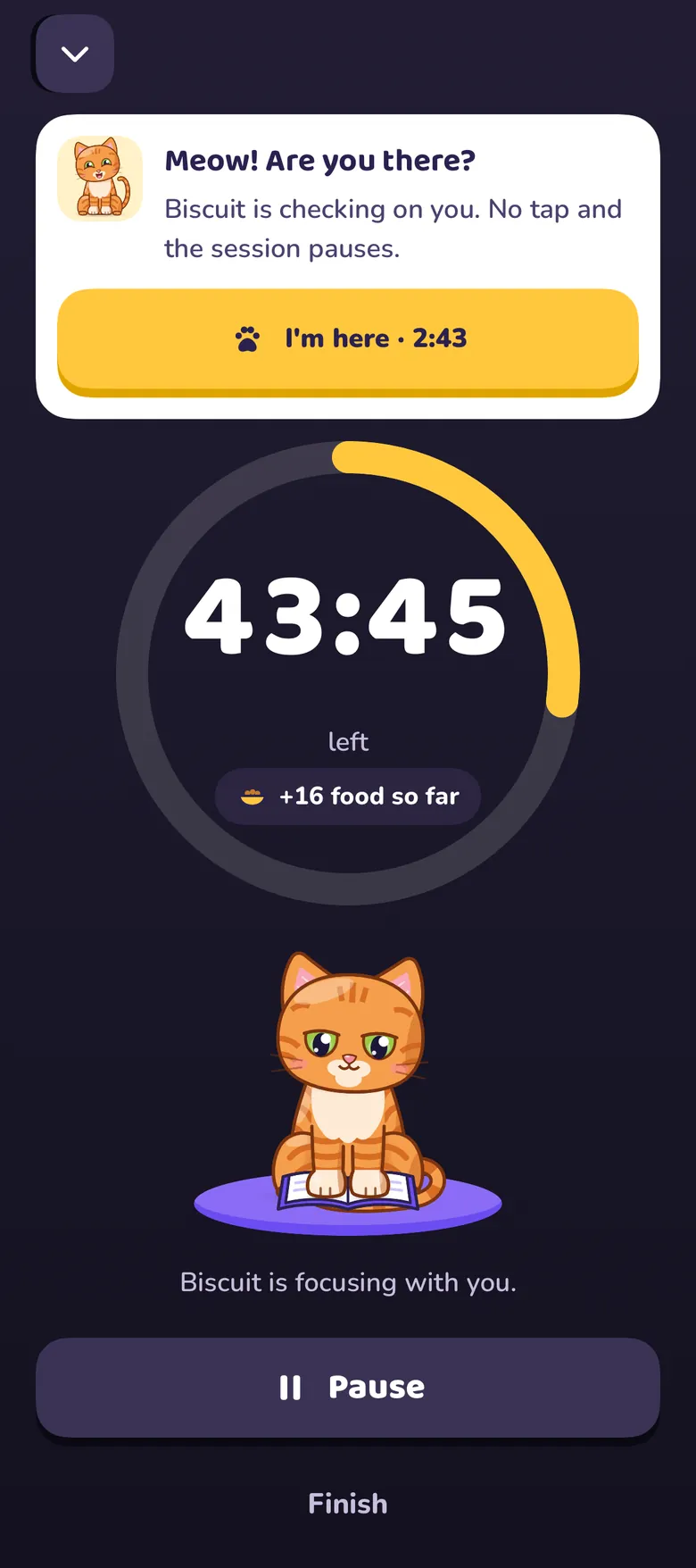
With three or four subjects and tuition on top, it's easy to keep studying your favourite subject while the hardest one gets the leftovers. Each Sunday, compare where your focused minutes went with where your marks are weakest.
Coming from IGCSE, or weighing the IB instead? See our guides to IGCSE revision and the IB Diploma.
Cambridge A Level FAQ
Should I sit AS exams after the first year?
It depends on your school's route and your subjects. The staged route spreads the load over two exam seasons, but your AS result only counts within 13 months. The linear route puts everything at the end. Ask your exams officer which entry option you're on.
How long does my AS result count towards the A Level?
For 13 months. Within that window it can be carried forward twice, for example from a June AS to that November and the following June. After that, it still stands as an AS Level qualification.
What happens if I don't get an E at A Level?
You may still be awarded a compensatory AS Level, based on the components the AS and A Level share, if your performance meets the AS standard.
Is Cambridge or Edexcel IAL easier to revise for?
Neither is simply easier. Cambridge examines each subject in AS and A2 blocks in June and November, while Edexcel IALs split subjects into unit exams across three series a year. Revise the way your board examines.
Sources and further reading
- Cambridge International Education: Which grades are available at AS/A Level?
- Cambridge International Education: What is a staged assessment?
- Cambridge International Education: How long do Cambridge International A and AS Levels take to complete?
- Pearson: About Edexcel International Advanced Levels
- Dunlosky, J., Rawson, K. A., Marsh, E. J., Nathan, M. J., & Willingham, D. T. (2013). Improving students' learning with effective learning techniques: Promising directions from cognitive and educational psychology. Psychological Science in the Public Interest, 14(1), 4–58.
- Karpicke, J. D., & Blunt, J. R. (2011). Retrieval practice produces more learning than elaborative studying with concept mapping. Science, 331(6018), 772–775.
- Rohrer, D., & Taylor, K. (2007). The shuffling of mathematics problems improves learning. Instructional Science, 35(6), 481–498.
- Hirshkowitz, M., Whiton, K., Albert, S. M., et al. (2015). National Sleep Foundation's sleep time duration recommendations: Methodology and results summary. Sleep Health, 1(1), 40–43.

By the Study Buddy Cat team
We are the small team behind Study Buddy Cat, a study timer where every focused minute feeds a cat. We write about the study habits we build into the app, drawing on learning research and on what students tell us.
Keep reading
-
 Exam guides
How to Study for the IB Diploma: Revision Plan and Timetable
Two years of IB in one plan: how the 45 points work, when to fit in IAs and the EE, a weekly timetable, subject tips, past papers and the final four weeks. -
 Exam guides
How to Revise for IGCSE: A Two-Year Plan and Timetable
An IGCSE plan for Year 10 and Year 11: Core or Extended, A* to G and 9 to 1 grades, a weekly revision timetable, subject tips, past papers and exam season. -
 Planning and exams
How to Make a Study Schedule You'll Actually Stick To
A six-step method for a weekly study schedule that fits your real life, with school-week and exam-season templates and a 15-minute review checklist.

Make your next study session count
Study Buddy Cat turns every verified minute of focus into food for your cat. No account or paywall to start, no ads, and when you take a break, your cat waits for you.