How to Prepare for JAMB: UTME Study Plan and Timetable
A JAMB plan that works alongside SS3: the CBT format, your subject combination, a weekly timetable, CBT practice with past questions and the final four weeks.

On this page
- The UTME at a glance: format, scores and what they decide
- When to start: a phased JAMB plan for SS2 and SS3
- A weekly JAMB timetable that fits school
- Subject strategy: Use of English and your three subjects
- Past questions, CBT practice and your error log
- The last 4 weeks and exam day
- Stress, sleep and rest days
- Where Study Buddy Cat fits
- JAMB UTME FAQ
In short
- The UTME is a computer-based test in Use of English plus three subjects chosen for your course: 180 questions in two hours, scored out of 400.
- Check your course's subject combination and O'level requirements on JAMB's IBASS first, then aim well above the minimum: JAMB set 150 for universities in 2026, and institutions can ask for more.
- Start by early SS3 with 1–2 focused hours on school days, cover the syllabus with past questions by the end of first term, then switch to timed CBT practice and an error log.
- The Federal Ministry of Education's proposed 2027 timetable puts the UTME in March, before NECO and WAEC, so your UTME peak comes in SS3 second term.
The UTME (Unified Tertiary Matriculation Examination) decides whether you can be offered a place at a Nigerian university, polytechnic or college of education. JAMB conducts it once a year as a computer-based test: Use of English plus three subjects that match your course, 180 questions in two hours, scored out of 400. Your UTME score, your O'level results (WAEC or NECO) and the institution's own screening then decide admission, and the offer itself comes through JAMB's Central Admissions Processing System (CAPS).
Start in SS2 if you can, and no later than the beginning of SS3. With school and lessons, a realistic load is 1–2 focused hours on school days and 3–4 hours on Saturday, roughly 10–14 hours a week, rising in the December holiday and the final weeks. The plan in one line: learn the JAMB syllabus topic by topic with past questions, finish it by the end of first term, then spend the last two to three months on timed CBT practice and an honest error log.
The Federal Ministry of Education's proposed 2027 timetable puts the UTME in March (the 2026 UTME was in April), ahead of NECO and WAEC, so your UTME peak falls in SS3 second term. Confirm final dates only on JAMB's official channels.
The UTME at a glance: format, scores and what they decide
| Item | What to know |
|---|---|
| Conducted by | JAMB (Joint Admissions and Matriculation Board), once a year |
| Format | Computer-based test (CBT) at JAMB-accredited centres; you log in with biometric verification |
| Subjects | Four: Use of English (compulsory) plus three subjects required for your course |
| Questions and time | 180 questions in 2 hours, about 40 seconds per question on average |
| Score | Out of 400 |
| When | April in 2026; proposed for March in 2027 |
| Mock | Optional; you choose "UTME with Mock" when you register. In 2026 it came a few weeks before the main exam |
| Answering | Press A, B, C or D to answer, N for next, P for previous, S to submit, then Y to confirm or R to go back |
More than 2.1 million candidates sat the 2026 UTME, according to JAMB's 2026 policy meeting presentation.
What your JAMB score decides
- JAMB's minimum is a floor, not a target. For 2026 admissions, JAMB's policy meeting approved minimum tolerable admission scores of 150 for universities and colleges of nursing, and 100 for polytechnics, monotechnics, colleges of agriculture, colleges of education and innovation enterprise institutions.
- Each institution sets its own bar. In JAMB's own words, "No UTME score is a cut-off mark": institutions set a minimum that can be equal to or higher than JAMB's, and they are free to run post-UTME screening. Check your first-choice school's admission page for its own requirements.
- For perspective: in JAMB's 2026 figures, about one in five candidates who sat the exam scored 200 or more. Popular courses at popular universities usually need more than the minimum, so set a target with a margin.
- O'level results count too. Upload them to the JAMB portal. You can register for the UTME while awaiting WAEC or NECO results, but you can't be admitted on "awaiting result" status.
- Admission happens on CAPS. Offers appear there and you accept or reject them yourself, within a time limit JAMB sets.
Check your subject combination on IBASS first
Before you buy a single textbook, look up your course on IBASS, JAMB's Integrated Brochure and Syllabus System, and write down your three UTME subjects, the O'level subjects you need credits in, and any extra conditions at your first-choice institution. A good score in the wrong combination is a wasted year. The usual combinations by track (your exact course can differ):
| Track | Typical UTME subjects | Plan around |
|---|---|---|
| Medicine & health | Use of English, Biology, Chemistry, Physics | Biology has the widest syllabus, so start it first |
| Engineering & science | Use of English, Mathematics, Physics, Chemistry | Calculation speed matters in all three |
| Law / Arts | Use of English, Literature-in-English, Government, CRS | Check the set texts for your year in the syllabus |
| Social sciences | Use of English, Mathematics, Economics, Government | Graphs and simple calculations in Economics |
| Accounting / Business | Use of English, Mathematics, Economics, Accounting | Daily practice on accounts and calculations |
When to start: a phased JAMB plan for SS2 and SS3
The phases below assume a UTME in March of your SS3 year, as in the proposed 2027 timetable. If your year's exam falls in April, slide everything by a month.
| Phase | When | What to do |
|---|---|---|
| Set-up | SS2 third term and the long holiday | Confirm your combination on IBASS; download the syllabus for each subject; list every topic and mark it green, yellow or red; start a daily 20-minute Use of English habit |
| Syllabus coverage | SS3 first term | Two or three topics a week per subject, each followed by 20–40 past questions on that topic the same week; a mixed 60-question quiz every Saturday |
| CBT practice | December holiday to February | Close leftover topics in the holiday; start timed sections on a computer or phone; by February, two full 180-question, 120-minute mocks a week, each reviewed the same day |
| Final weeks | Last 4 weeks before the UTME | Mocks, error log, rest (see below) |
Starting late, in SS3 second term? Skip rewriting notes. Solve past questions by topic, prioritise the topics that keep coming up, and do a full timed mock every week from the start.
Writing the UTME again after secondary school? First work out which subject lost the most marks, and why: topics never covered, time, or careless slips. Then run the same phases faster with 4–6 focused hours a day; more tends to turn into rereading (see how many hours to study a day).
A weekly JAMB timetable that fits school
Most SS3 students are in school from about 7:30 am to 2 or 3 pm, many have extra lessons afterwards, and the light doesn't always stay on. So plan a few protected blocks of about 50 minutes plus a 10-minute break, and keep a past-question book ready for when there's no power.
| Time | What to do |
|---|---|
| 5:45–6:15 | Use of English warm-up: one short passage or 15 vocabulary questions from yesterday's misses |
| 7:30–2:30 | School; jot down anything you didn't understand in class |
| 2:30–4:00 | Home, food, rest |
| 4:00–5:00 | Extra lesson or tutorial, if you attend one |
| 5:30–6:20 | Block 1: this week's topic in one subject, then past questions on it |
| 6:20–7:30 | Chores, dinner, family |
| 7:30–8:20 | Block 2: a second subject, same routine |
| 8:20–8:45 | Error log: redo three of today's misses, write tomorrow's first task |
| 9:30 | Phone away, lights out |
Rotate so each subject gets two blocks a week plus the Saturday test, with Use of English in the morning warm-up every day:
| Day | Block 1 | Block 2 |
|---|---|---|
| Monday | Subject A: new topic | Use of English: comprehension passage |
| Tuesday | Subject B: new topic | Subject C: past questions |
| Wednesday | Subject C: new topic | Use of English: vocabulary and sentences |
| Thursday | Subject A: past questions | Subject B: past questions |
| Friday | Error log only (one block) | Free evening |
| Saturday | Timed mixed test: 60 questions in 40 minutes early on, the full 180 in 120 minutes from the CBT phase | Review every miss |
| Sunday | Rest, worship, family; at most 30 minutes of flashcards | Off |
In the December holiday, run three or four blocks a day, keep Sunday light, and fit in some exercise or a walk. A detailed method for building your own week is in our study schedule guide.
Subject strategy: Use of English and your three subjects
Use of English: compulsory for everyone
- Read every day: a short passage from a past question, an editorial or a novel, then write its main idea in one sentence without looking.
- Learn words in context. Keep a notebook of every word that tricked you and test yourself twice a week. Nearest- and opposite-meaning questions reward the meaning in that sentence, not the "biggest" word.
- Say sounds out loud when your past-question book has questions on vowels, consonants or stress.
- Read any prescribed text in full. If the syllabus on IBASS lists one for your year, read it twice and make cards for characters, events and themes.
- Where marks go: rereading long passages under time pressure, and picking answers that are true in real life but not stated in the passage.
Science subjects: Medicine & health, Engineering & science
- Biology is wide rather than deep: learn a topic, then recall it from memory (stages, labelled diagrams) and check against the book.
- Chemistry mixes calculations with facts. Keep a formula sheet and rewrite it from memory every week.
- Physics and Mathematics are won by solving: 20–30 questions after each topic, then mixed sets, as in the real exam.
- Where marks go: long calculations eating time, unit slips and look-alike options. Practise quick estimates to rule options out.
Arts, social science and commercial subjects
- Literature-in-English: know your year's set texts (listed in the syllabus) plot by plot, plus literary terms and unseen poetry. JAMB's list can differ from WAEC's.
- Government: build a timeline of Nigerian political history and institutions from memory and test yourself on it.
- CRS: learn the passages the syllabus names and link each one to its theme.
- Economics and Accounting: practise graphs, calculations and account formats daily; definitions alone won't carry you.
- Where marks go: options that are almost right. Read every option before choosing.
Managing 180 questions in 120 minutes
- Two passes. Answer what you know, use N to move past anything slow, then come back with P.
- Check the clock at 60 minutes. You should be past halfway; if not, speed up on the easy questions.
- Don't leave blanks by accident. A blank can't earn a mark, so unless the on-screen instructions say otherwise, pick your best option before you submit.
- Submit on purpose. S starts the submission, Y confirms it and R takes you back; practise the order in mocks.
Past questions, CBT practice and your error log
Past questions show you the syllabus the way JAMB actually tests it. In a 2013 review of ten study techniques, John Dunlosky and colleagues rated practice testing and spreading study over time as the most useful, and rereading and highlighting low. In Henry Roediger and Jeffrey Karpicke's 2006 experiments, students who practised recalling a passage remembered more a week later than students who reread it. The method is in our guide to active recall and spaced repetition.
- By topic first, then mixed. In a 2007 study by Doug Rohrer and Kelli Taylor, students who practised maths problems in shuffled order did worse during practice but clearly better on a test a week later. Mix topics from the CBT phase on.
- Practise on a screen, with the A–D, N and P keys, so they feel automatic. Third-party CBT apps aren't affiliated with JAMB, so check that their questions match the current syllabus.
- Take the official mock if you can, as a rehearsal of the centre, login and keys, not a prediction of your score.
Review every mock the same day and log every miss, including lucky guesses:
| Reason | Example | Fix |
|---|---|---|
| Topic gap | Never learnt equilibrium properly | Relearn it, then 15 past questions on it |
| Misread | Missed "NOT" in the question | Read every question stem twice |
| Slow | Four minutes on one Physics question | Move on with N, come back at the end |
| Careless | Wrong sign in a calculation | Write units and signs at every step |
The last 4 weeks and exam day
- Weeks 4 to 2: three full timed mocks a week at the time of day you expect to write, each reviewed the same day. In between, go through your error log and formula sheets. No new textbooks.
- The final week: one mock early in the week, then light review. Confirm your centre, date and session only through JAMB's official channels, and visit the centre beforehand if you can.
- The night before: pack what you're allowed to bring, and nothing else. JAMB's 2024 centre handbook barred phones, wristwatches and other electronic devices from the exam hall; follow the rules for your year. Then sleep.
- Eat something that suits you and leave early; centres can be far and traffic is unpredictable.
- Expect queues for biometric verification. Only candidates who are verified can sit the exam.
- Read the on-screen instructions and check that your four subjects are the ones you registered.
- Work in two passes and check the clock at 60 minutes.
- Submit with S, then Y, only when you're done.
Ignore anyone selling "runs" or "expo". JAMB withholds results and works with the police when it detects malpractice; in 2026 it reported illegal remote access to candidates' computers at one centre. After the exam, check your result through JAMB's official channels, upload your O'level results if you haven't, and keep an eye on CAPS.
Stress, sleep and rest days
The JAMB year comes with pressure: everyone asking your score, comparisons with cousins, the feeling that one exam decides everything. A mock score is a measurement, not a verdict; your benchmark is whether last month's mistakes are still in your error log.
Sleep is part of the plan. A National Sleep Foundation expert panel recommends 8–10 hours a night for teens aged 14–17 and 7–9 hours for those aged 18–25 (Hirshkowitz and colleagues, 2015); more in our guide to sleep and studying. Keep one lighter day a week.
If stress has been affecting your sleep, appetite or daily life for weeks, talk to a parent, teacher, school counsellor or doctor. For everyday coping, read our guide to dealing with exam stress.
Where Study Buddy Cat fits
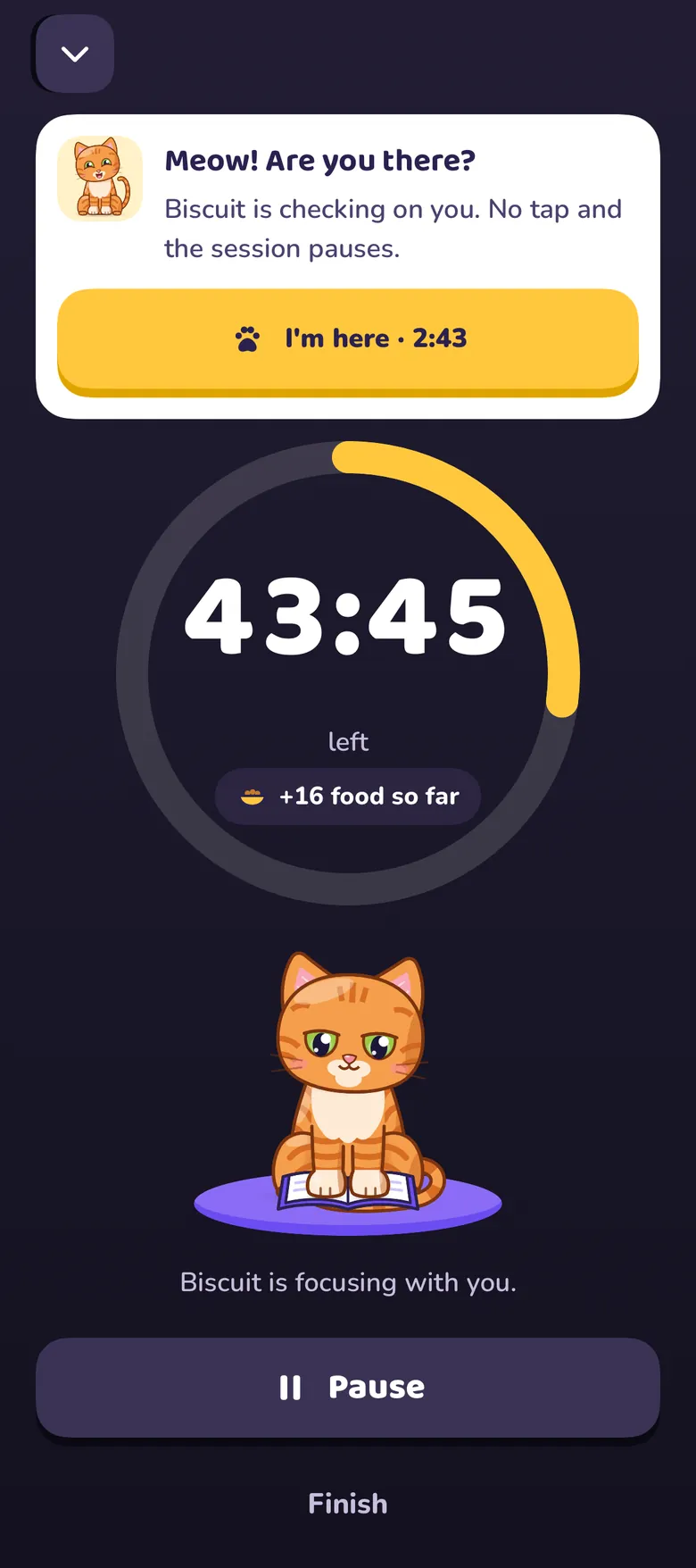
A JAMB plan only works if the blocks actually happen. Each Sunday, compare where your focused minutes went with where your mock marks went: if one subject keeps losing marks but gets the fewest minutes, give it next week's first block.
JAMB UTME FAQ
How many hours a day should I study for JAMB?
With school and lessons, 1–2 focused hours on school days and 3–4 on Saturday. In the December holiday and the final weeks, 3–5 a day. After secondary school, 4–6 focused hours is plenty.
What is a good JAMB score?
JAMB's 2026 minimum for universities was 150, but that only makes you eligible. About one in five candidates scored 200 or more in 2026, and competitive courses usually need more. Check your institution's own requirements and aim above them.
Can I write JAMB with "awaiting result"?
Yes, you can register while awaiting WAEC or NECO results, but you can't be admitted on that status. Upload your O'level results to the JAMB portal as soon as they're out.
Is the JAMB mock exam compulsory?
No, it's optional; you choose it when you register. It's worth taking to practise the centre, the login and the keyboard.
Sources and further reading
- Joint Admissions and Matriculation Board: Joint Admissions and Matriculation Board (home page)
- Joint Admissions and Matriculation Board: 2026 Policy Meeting presentation
- Joint Admissions and Matriculation Board: Frequently Asked Questions
- Federal Ministry of Education: FG Harmonizes 2027 Examination Timetable, Targets August Results Release
- Roediger, H. L., & Karpicke, J. D. (2006). Test-enhanced learning: Taking memory tests improves long-term retention. Psychological Science, 17(3), 249–255.
- Dunlosky, J., Rawson, K. A., Marsh, E. J., Nathan, M. J., & Willingham, D. T. (2013). Improving students' learning with effective learning techniques: Promising directions from cognitive and educational psychology. Psychological Science in the Public Interest, 14(1), 4–58.
- Rohrer, D., & Taylor, K. (2007). The shuffling of mathematics problems improves learning. Instructional Science, 35(6), 481–498.
- Hirshkowitz, M., Whiton, K., Albert, S. M., et al. (2015). National Sleep Foundation's sleep time duration recommendations: Methodology and results summary. Sleep Health, 1(1), 40–43.

By the Study Buddy Cat team
We are the small team behind Study Buddy Cat, a study timer where every focused minute feeds a cat. We write about the study habits we build into the app, drawing on learning research and on what students tell us.
Keep reading
-
 Exam guides
How to Prepare for WAEC: WASSCE Study Plan for SS3
A WAEC plan for SS3 in Nigeria: subjects and papers, a term-by-term timeline, a weekly timetable, past questions with examiners' comments and the final weeks. -
 Exam guides
How to Prepare for NECO: SSCE Study Plan and Timetable
A NECO SSCE plan for SS3: how it fits with WAEC and JAMB, a phased timeline, term-time and exam-season timetables, past questions and the final weeks. -
 Planning and exams
How to Make a Study Schedule You'll Actually Stick To
A six-step method for a weekly study schedule that fits your real life, with school-week and exam-season templates and a 15-minute review checklist.
Make your next study session count
Study Buddy Cat turns every verified minute of focus into food for your cat. No account or paywall to start, no ads, and when you take a break, your cat waits for you.