How to Study for the HSC: Year 12 Study Plan and Timetable
An HSC plan from the start of Year 12 to the exams: how the 50/50 mark and bands work, a weekly timetable around school, trials, past papers and final weeks.

On this page
- How the HSC works: units, marks, bands and the ATAR
- When to start: a term-by-term HSC plan
- A weekly HSC study timetable around school
- Strategy by course pattern: Science, Humanities and Health
- Past papers, marking guidelines and the error log
- The last 4 weeks and exam day
- Stress, sleep and rest days
- Where Study Buddy Cat fits
- HSC FAQ
In short
- Each HSC mark is half your moderated school assessment mark and half your exam mark, so every Year 12 assessment task counts as much as the written exams in October and November.
- Work steadily from the day your HSC courses begin, switch to timed NESA past papers in Term 3 and the spring holidays, and expect about 15–20 focused hours a week on top of school.
- Mark every practice answer against NESA's marking guidelines and keep an error log, because testing yourself beats rereading notes.
- The ATAR is a separate rank calculated by UAC from your best 2 units of English and best 8 other units after scaling, so choose courses you can do well in.
The HSC decides two things: the mark and band you get in each course, and, through the Universities Admissions Centre (UAC), your ATAR, the rank most universities use for entry. Every HSC mark is half school assessment and half written exam, so the HSC doesn't start in the spring holidays. It starts with your first Year 12 assessment task. For most students, a realistic load is 2–3 focused hours on school nights plus one longer block on the weekend: about 15–20 hours a week, more around trials and in the last holidays.
How you study matters more than how long. Learn each topic as it's taught, test yourself on it within a few days, and from Term 3 spend most of your time on NESA past papers marked against the official marking guidelines.
How the HSC works: units, marks, bands and the ATAR
The HSC is run by NESA, the NSW Education Standards Authority. This is the structure for the 2026 and 2027 HSC, from NESA and UAC:
| Part | What it is | What it means for you |
|---|---|---|
| Courses | At least 12 units of Preliminary courses (usually Year 11) and 10 units of HSC courses (usually Year 12); most courses are worth 2 units | Plan on at least 10 units in Year 12: five 2-unit courses or more |
| English | Compulsory: English Studies, English Standard, English Advanced or EAL/D; English Extension 1 and 2 build on Advanced | Your best 2 units of English always count towards the ATAR |
| School assessment | Tasks, due dates and weightings set by your school, then moderated by NESA | 50% of each HSC mark |
| HSC exams | Written exams from mid-October to early November; some courses also have practical or oral exams on their own timetables | 50% of each HSC mark |
| Minimum standard | Short online tests in reading, writing and numeracy; you need Level 3 or 4 | Required to receive the HSC |
| Results | An HSC mark and a band for each course: Band 6 = 90–100, Band 5 = 80–89, Band 4 = 70–79, Band 3 = 60–69, Band 2 = 50–59, Band 1 = 0–49; extension courses use E1–E4 | Released in December |
| ATAR | Calculated by UAC from scaled marks: best 2 units of English plus your best 8 other units, on a scale from 0.00 to 99.95 | A rank for university entry, separate from the HSC itself |
Two details are worth knowing. First, your exam mark isn't a raw score: NESA aligns it to the band scale, so 90 is the lowest mark that still lands in Band 6. Second, since the 2025 HSC, any course with an HSC exam can count towards the ATAR, and the old limit on Category B units (such as English Studies and Mathematics Standard 1) is gone.
Moderation: why your rank at school matters
Your school sends NESA an assessment mark for every student in each course. NESA then moderates the group against how that same group did in the HSC exam: the group's average, top and (where possible) bottom assessment marks are matched to its exam marks. Your rank within your school stays the same, and so do the gaps between students.
In practice:
- Your rank carries through. A tough marker doesn't hurt you if the whole class is marked the same way; slipping below classmates does.
- Your classmates' exam marks lift the whole group, so a good study group raises everyone's moderated assessment marks.
- Don't skip tasks. You must make a genuine attempt at tasks worth more than 50% of a course's marks, or you risk an "N determination" (course not satisfactorily completed). Your school gives you an assessment schedule at the start of the course and a task notice, usually at least two weeks before each due date.
When to start: a term-by-term HSC plan
NSW schools run four terms with holidays in between, and many schools start HSC courses in Term 4 of Year 11. Count your plan from that point:
| When | Main job | What it looks like |
|---|---|---|
| Year 11 | Build the base | Learn to test yourself instead of rereading; keep maths and science foundations solid, because Year 12 builds on them |
| HSC courses begin to end of Term 1 | Set up the system | Put every assessment date into one calendar; 10 minutes of recall after each lesson; a weekly set of practice questions per course |
| Term 2 | Assessment season | Start preparing each task two to three weeks out; after every task, log what cost marks; keep doing past-paper questions by topic |
| Term 3 | Trials | Finish content; full timed past papers for each course; review trial papers question by question |
| Spring holidays | Exam rehearsal | One or two timed papers a day, marked against the marking guidelines; English essays under time |
| Exam period | One exam at a time | Short revision of the next exam's error log; rest between papers |
Most schools run trial HSC exams in Term 3. Whether they count as an assessment task depends on your school's schedule; either way, they're your best full rehearsal.
Starting late? Skip rewriting notes. Rate each syllabus dot point green, yellow or red and go straight to past-paper questions on the red ones. Remaining assessment tasks still count for half, so prepare those first.
A weekly HSC study timetable around school
Most NSW schools finish around 3 pm. The idea is three protected blocks on school nights, 50 minutes of focus and 10 minutes of break each, with the hardest work first. Adjust the times to your sport, job and travel:
| Time | What to do |
|---|---|
| 3:30–4:15 | Home, eat, move; phone on the charger in another room |
| 4:15–5:05 | Block 1: the hardest course (often maths problems) |
| 5:15–6:05 | Block 2: the next assessment task, or recall on today's lessons |
| 6:05–7:30 | Dinner, training, family |
| 7:30–8:20 | Block 3: practice questions or one section of a past paper |
| 8:30–8:50 | Five quick questions on today's lessons; write tomorrow's first task |
| From 9:30 | Wind down, screens away, sleep |
That's about 2.5–3 focused hours. Across the week, rotate so every course gets two or three blocks. Here's an example for the Science pattern (English Advanced, Maths Advanced, Maths Extension 1, Chemistry, Physics, Biology):
| Day | Block 1 | Block 2 | Block 3 |
|---|---|---|---|
| Monday | Maths Advanced problems | Chemistry | English: one timed paragraph |
| Tuesday | Physics | Maths Extension 1 | Biology |
| Wednesday | Maths, mixed topics | English: quotes and ideas from memory | Chemistry |
| Thursday | Physics | Biology | Maths Extension 1 |
| Friday | Error log and next week's plan (one block) | Off | Off |
| Saturday | Timed past-paper section, one course (rotate) | Mark it against the guidelines | Off from mid-afternoon |
| Sunday | Rest day, or a job shift | Off | Optional: one English block |
If you work weekends, move the long block. In the holidays, the shape changes: three blocks in the morning, two after lunch, then stop. Five or six focused hours is a strong holiday day; past that, it usually turns into rereading (more in how many hours to study a day).
Strategy by course pattern: Science, Humanities and Health
English: everyone's 2 units
- Know your texts by idea, not by plot: a page per idea with three to five pieces of evidence and what each shows, rewritten from memory every couple of weeks.
- Write under time, often: a timed paragraph a week during term, full timed responses from Term 3, and teacher feedback on some of them.
- Answer the question you're given, reshaping your ideas instead of memorising one essay.
- Where marks go: a prepared essay that doesn't answer the question, retelling instead of analysing, and evidence with no explanation.
Science pattern: Maths Advanced, Maths Extension 1, Chemistry, Physics, Biology
- Maths is daily problems. Do a small set every school night. Once a topic is learned, mix it with older ones: in a 2007 study by Doug Rohrer and Kelli Taylor, students who practised maths problems in shuffled order did worse during practice but clearly better on a test a week later.
- Sciences are explanations plus calculations. Practise extended-response questions and compare your answer with the marking guidelines to see what earns each mark. Keep units and working in every calculation.
- Where marks go: skipped working, unit and sign errors, and "explain" questions answered with a description.
Humanities pattern: Maths Standard, Modern History, Legal Studies, Business Studies, Economics
- Turn syllabus content into questions and write skeleton answers from memory, then check against your notes.
- Keep a file of examples. Legal Studies, Business Studies and Economics answers need current, specific examples: cases, businesses, recent data. Add one a week.
- Don't let Maths Standard slide. Two blocks a week of applied problems keep it from becoming a surprise in the exam.
- Where marks go: memorised responses that ignore the question, no examples, and running out of time on extended responses.
Health pattern: English Standard, Maths Standard, Biology, PDHPE, Business Studies, Community and Family Studies
- PDHPE and Community and Family Studies reward clear, well-supported extended responses: practise planning answers in five minutes, then writing them under time.
- Biology: draw and explain processes from memory, then check; practise data and experiment questions from past papers.
- Where marks go: long answers that describe instead of explaining, and examples that don't match the question.
Past papers, marking guidelines and the error log
NESA publishes past HSC exam papers for every course, with marking guidelines and HSC marking feedback, on its HSC exam papers page. Use those before anything else; trial papers from other schools vary in quality.
Why papers beat rereading: in a 2013 review of ten study techniques, John Dunlosky and colleagues rated practice testing and spacing practice over time as the most useful, and rereading and highlighting as low. In Henry Roediger and Jeffrey Karpicke's 2006 experiments, students who reread a passage did better on a test minutes later, but students who practised recalling it remembered more a week later. The full method is in our guide to active recall and spaced repetition.
How to use past papers by stage:
- Terms 1–2: questions on the topics you've just finished, open-book at first, then closed.
- Term 3 and holidays: full papers under exam time, in one sitting.
- Every time: mark strictly with the marking guidelines, read the marking feedback for that question, and log every lost mark.
| Reason you lost marks | Example | Fix |
|---|---|---|
| Didn't know it | Couldn't start a probability question | Relearn from class notes, then do five similar questions |
| Didn't answer the question | Described a cause when asked to evaluate it | Underline the key verb; plan the answer before writing |
| Careless | Dropped a negative sign | Check one line at a time in practice papers for a week |
| Not enough depth | An extended response with no specific example | Add examples to your file and practise one response a week |
| Ran out of time | Last extended response half done | Plan minutes per section and practise to that plan |
The last 4 weeks and exam day
The written exams run from mid-October to early November, right after the spring holidays. Get the official HSC written exam timetable from NESA's website and plan backwards from your own papers.
- Weeks 4 to 2: one or two timed papers a day in the holidays, each marked the same day; in between, error logs and English practice.
- The final week before your first exam: lighter. Shorter sections, recall from memory, no new resources.
- During the exam period: prepare for one exam at a time. The evening before each paper is for the error log and a one-page summary, not new content.
- Body clock: if your exams are in the morning, do your timed papers in the morning too.
The 2027 Rules and Procedures guide sets the basics: phones, study notes, programmable watches, smart glasses and wireless earphones stay out of the exam room; you can't write or highlight during reading time; and you can't leave in the first hour or the last 15 minutes. If you get sick or something goes wrong just before or during an exam, ask your school about an illness/misadventure application.
- Arrive early: at least 30 minutes early for the first English exam and all online exams, 10 minutes for the others.
- Bring only approved equipment, including a NESA-approved calculator where your course allows one, and check that it works.
- Use reading time to plan, choosing your order and the questions you'll do first.
- Keep to your time plan and move on when a question stalls.
- Afterwards, don't pick the paper apart in the group chat. Switch to the next exam.
Stress, sleep and rest days
Year 12 in NSW comes with its own noise: ATAR predictions, ranking talk after every task, and trial results that feel final but aren't. Your real benchmark is your error log: are the same mistakes still there?
Sleep is part of the plan. A National Sleep Foundation expert panel recommends 8–10 hours a night for teens aged 14–17 and 7–9 hours for those aged 18–25 (Hirshkowitz and colleagues, 2015); more in our guide to sleep and studying. Keep one lighter day a week.
Some nerves are normal. If stress affects your sleep, eating or everyday life for weeks, talk to your school counsellor, your GP or a trusted adult; Kids Helpline and headspace also offer support for young people. If you ever think about harming yourself, tell someone you trust straight away. For everyday coping, see how to deal with exam stress.
Where Study Buddy Cat fits
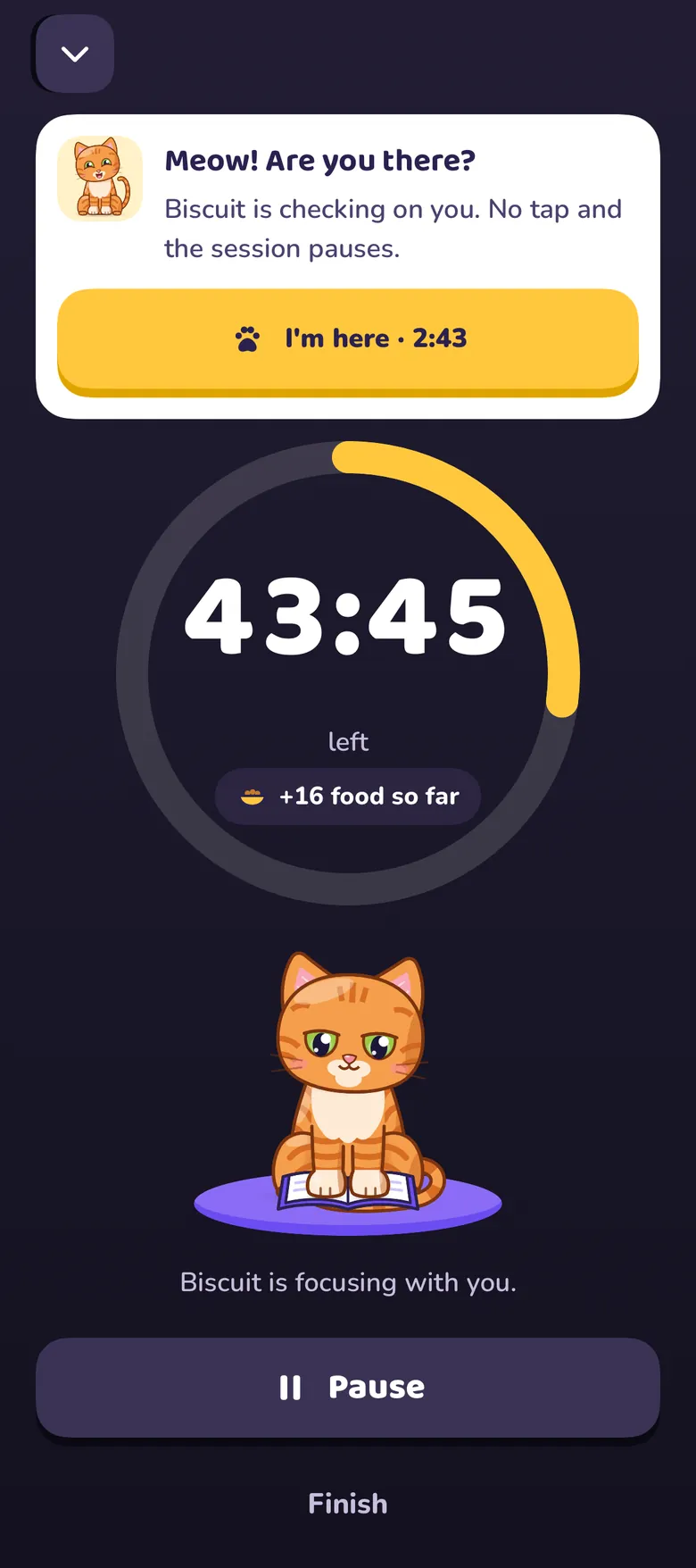
An HSC plan only works if the blocks happen. Once a week, compare where your focused time went with where you're losing marks: if Chemistry costs the most marks but got the fewest minutes, it goes first next week.
If you're comparing notes with friends interstate, our guide to studying for the VCE covers the Victorian system.
HSC FAQ
How many hours a day should I study for the HSC?
During term, 2–3 focused hours on school nights and one longer weekend block is a strong routine, about 15–20 hours a week. In the holidays before the exams, 5–6 focused hours a day is plenty; beyond that, extra hours usually turn into rereading.
When should I start studying for the HSC?
When your HSC courses begin, because school assessment is half of every HSC mark. Serious exam practice with full past papers usually starts in Term 3, around trials.
What's the difference between my HSC mark and my ATAR?
Your HSC mark is a mark out of 100 for each course, with a band, from NESA. The ATAR is a separate rank from UAC, from 0.00 to 99.95, built from scaled marks in your best 2 units of English and best 8 other units. It's used for university entry.
What mark do I need for a Band 6?
An HSC mark of 90 or more in a 2-unit course. Because the HSC mark averages your exam mark and your moderated assessment mark, strong assessment results and a strong exam both matter.
Sources and further reading
- NSW Education Standards Authority: About the HSC
- NSW Education Standards Authority: Determining results
- NSW Education Standards Authority: HSC key dates
- Universities Admissions Centre: ATAR
- Dunlosky, J., Rawson, K. A., Marsh, E. J., Nathan, M. J., & Willingham, D. T. (2013). Improving students' learning with effective learning techniques: Promising directions from cognitive and educational psychology. Psychological Science in the Public Interest, 14(1), 4–58.
- Roediger, H. L., & Karpicke, J. D. (2006). Test-enhanced learning: Taking memory tests improves long-term retention. Psychological Science, 17(3), 249–255.
- Rohrer, D., & Taylor, K. (2007). The shuffling of mathematics problems improves learning. Instructional Science, 35(6), 481–498.
- Hirshkowitz, M., Whiton, K., Albert, S. M., et al. (2015). National Sleep Foundation's sleep time duration recommendations: Methodology and results summary. Sleep Health, 1(1), 40–43.

By the Study Buddy Cat team
We are the small team behind Study Buddy Cat, a study timer where every focused minute feeds a cat. We write about the study habits we build into the app, drawing on learning research and on what students tell us.
Keep reading
-
 Exam guides
How to Study for the VCE: Year 12 Study Plan, SACs and Exams
A plan for Units 3 and 4: how SACs, exams and study scores work, a weekly timetable around school, the GAT, VCAA past exams and the last weeks before exams. -
 Planning and exams
How to Make a Study Schedule You'll Actually Stick To
A six-step method for a weekly study schedule that fits your real life, with school-week and exam-season templates and a 15-minute review checklist. -
 Study techniques
Active Recall and Spaced Repetition: How to Study Effectively
Stop rereading and start remembering: how to use active recall and spaced repetition, with a 1-3-7-14-30 review schedule and notes turned into questions.

Make your next study session count
Study Buddy Cat turns every verified minute of focus into food for your cat. No account or paywall to start, no ads, and when you take a break, your cat waits for you.